AHK-Cu
Also called alanyl-histidyl-lysine copper, copper tripeptide-3 (on labels)
We may earn a commission from links on this page. It never decides our picks. How we make money
AHK-Cu is GHK-Cu's hair-focused cousin: the same copper peptide with alanine in place of glycine. One lab study found it lengthened human hair follicles in a dish. No study has tested it on a living person's scalp.
Related copper peptide: GHK-Cu, the better-studied one, mostly for skin
In this guide
At a glance
| What it is | Alanine–histidine–lysine bound to one copper ion; a lab-made variant of the natural peptide GHK |
|---|---|
| Sold as | Hair and scalp serums, often combined with GHK-Cu |
| Best evidence | One lab study on human scalp follicles (2007) |
| No human evidence for | Hair growth, hair loss, skin aging, or anything else |
| Dose clue | The lab benefit appeared at tiny concentrations and reversed at higher ones |
| Main risks | Unknown; no published safety or allergy testing found |
| Typical cost | About US$50 to $229 per serum |
Where to get it
MoveWell sells no peptides. All options and prices
FDA-approved treatments with human trials. Start here before any copper peptide.
ComparePick one that states its AHK-Cu strength. Strengths on sale run from 1% to 8%.
Compare 6 serumsBulk liquids and research vials aren't made or tested for direct use on people.
WhyMolecular structure
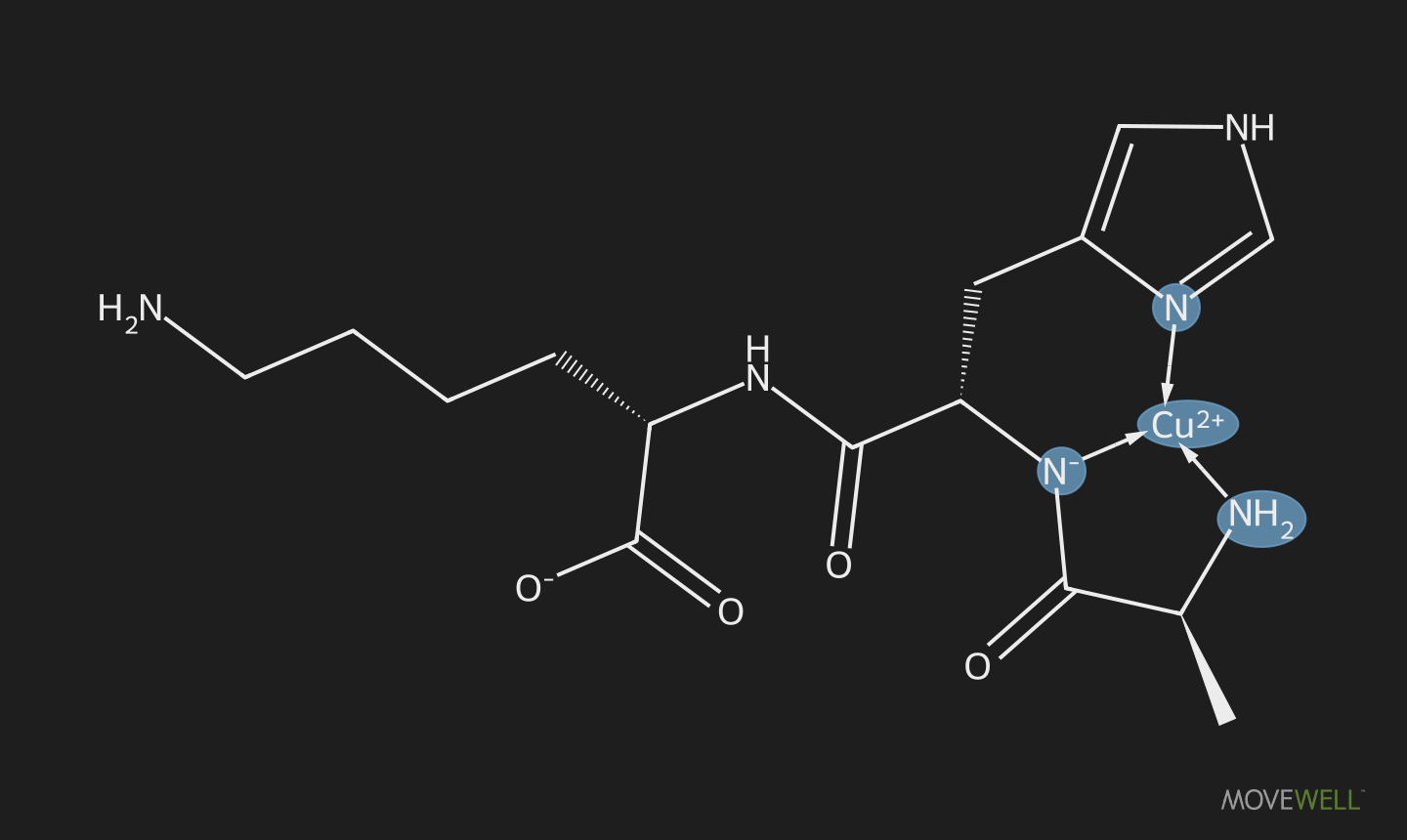
Built like GHK-Cu, with one extra methyl group on the first amino acid. Three nitrogens hold the copper ion.
Copper and the three nitrogens that bind it
The AHK peptide alone, without copper. Drag to rotate
- Sequence
- Ala-His-Lys
- Formula
- C15H24CuN6O4
- Weight
- ≈415.9 g/mol
- Peptide alone
- C15H26N6O4, 354.4 g/mol
- CAS
- 767286-83-9
- AHK CAS
- 126828-32-8
- FDA UNII
- 1AVY5QO8WR (AHK)
- ChEBI
- 158225
- EU CosIng
- Ref 31397
Copper binding drawn by analogy with GHK-Cu. PubChem ID not yet confirmed.5, 9
What it is
AHK is a man-made variant of GHK, the copper-carrying peptide found in human blood. Swapping glycine for alanine adds one small carbon group; the copper-binding end stays the same.5
It was developed by ProCyte, the company that commercialized copper peptides in the 1990s, whose patent describes it as a hair-growth agent.4 On cosmetic labels it appears as "copper tripeptide-3" or, in EU ingredient databases, as alanine/histidine/lysine polypeptide copper HCl. Don't confuse it with "tripeptide-3," an unrelated ingredient.7, 8
Evidence map
Lab only: 1 study on human follicles in a dish, plus unpublished mouse data in a patent
None found: skin claims borrow from GHK-Cu studies
Scale: 5 FDA-approved, 4 strong human, 3 limited human, 2 animal or lab only, 1 anecdotal
Key studies
| Study | Model | Finding |
|---|---|---|
| Pyo 20071 | Lab 240 follicles from 3 donors | Follicles grew longer and follicle cells multiplied at 10⁻¹² to 10⁻⁹ M; higher doses (10⁻⁸ to 10⁻⁷ M) held growth back. Cell-death markers dropped, but the fall in dying cells was not statistically significant. Funded partly by AmorePacific |
| ProCyte patent4 | Mouse | Topical AHK-Cu outperformed a related peptide; injections kept hair near the site during chemotherapy. Not peer-reviewed; numbers not public |
| Lee 20166 | Often miscited | A 45-man hair study, but it tested a GHK compound, not AHK-Cu |
No human trial of AHK-Cu was found, and brands selling it say the same.12
How it's used
Serums are applied to the scalp once or twice a day, sometimes after microneedling. Products state AHK-Cu at 1% to 8%, often next to GHK-Cu.
That raises a real question. In the only study, the benefit appeared at around a billionth of a mole per liter and reversed at higher concentrations.1 Retail serums are many orders of magnitude stronger. Nobody has tested whether more is better on a scalp, and the lab data hint it may not be.
Side effects and who should avoid it
- Unknown. We found no published toxicity, irritation or allergy testing for AHK-Cu. The 2018 cosmetic safety review of copper peptides covered GHK-Cu, not AHK-Cu.10
- Raw ingredient. Some sellers offer 10% AHK-Cu liquid meant for formulators. It isn't designed for direct use on skin.16
- Copper disorders. People with Wilson's disease or a copper allergy are usually told to avoid copper peptides. A precaution, not a studied risk.
- Pregnancy and breastfeeding. No data.
Compared with
| AHK-Cu | GHK-Cu | Minoxidil | Finasteride | |
|---|---|---|---|---|
| Status | Cosmetic | Cosmetic | FDA-approved, over the counter | FDA-approved, prescription (men) |
| Hair evidence | Lab only | None | Human trials | Human trials |
| Main use | Hair | Skin | Hair | Hair |
| Head to head | AHK-Cu has never been compared directly with GHK-Cu, minoxidil or finasteride | |||
Stacks
None of these combinations has been tested.
AHK-Cu + GHK-Cu
Rationale onlyThe most common pairing in hair serums. Neither has human hair data.
AHK-Cu + minoxidil
Rationale onlyAdds an untested ingredient to a proven one. If you try it, keep the minoxidil.
AHK-Cu + microneedling
Rationale onlyOne uncontrolled 2025 study used minoxidil, dutasteride and unnamed copper peptides together on the scalp, so it can't speak to AHK-Cu.13
Myths vs evidence
All options and prices
MoveWell sells no peptides. Sorted by stated AHK-Cu strength. Prices checked Oct–Nov 2026
| Product | AHK-Cu | Also contains | Size | Price |
|---|---|---|---|---|
| Neurogan AHK-Cu Hair Serum | 8% | — | 60 mL | $229 |
| Hairgenetix Copper Peptide Serum | 5% | 10% GHK-Cu | Not stated | €50 |
| Neurogan AHK + GHK Hair Serum Pro | 2.4 g per bottle | 2.4 g GHK-Cu | 60 mL | $185 |
| Nubeean Noosa Scalp Serum | 1% | — | 30 mL | AUD 75 |
| Hello Skin Multi-Peptide Hair Serum | 1% | 3% GHK-Cu | 30 mL | AUD 110 |
| Obibo Stimulating Serum | Not stated | — | Not stated | $64 |
Left off: raw 10% ingredient liquids sold to formulators, and "research use only" vials
Legal status
- Current statusA cosmetic ingredient in the US and EU (CosIng ref 31397). Not on FDA's 503A compounding lists in any category, as of the May 14, 2026 update.11, 7
- Cosmetic Ingredient Review covers GHK-Cu and related peptides; AHK-Cu not included.10
- ProCyte patent describes AHK-Cu for hair growth.4
AHK-Cu is not FDA-approved as a drug. Because it isn't on any compounding list, a pharmacy selling compounded AHK-Cu has no clear legal basis to do so.
FAQ
Does AHK-Cu regrow hair?
Unknown. One lab study found longer follicles in a dish; no study has tested it on people.
What's the difference between AHK-Cu and GHK-Cu?
One amino acid: alanine instead of glycine. GHK-Cu occurs naturally and has small human skin trials; AHK-Cu is lab-made and studied only in the lab. See our GHK-Cu guide.
Should I use it instead of minoxidil?
No. Minoxidil and finasteride have human trials and FDA approval for hair loss; AHK-Cu has neither.
What strength should I look for?
There's no evidence-based strength. Prefer products that state their AHK-Cu content so you know what you're using.
Is it safe?
No safety testing has been published. Patch-test first, and stop if your scalp gets irritated.
Is copper tripeptide-3 the same thing?
On product labels, usually yes. "Tripeptide-3" without copper is a different ingredient.
References
16 sources, with links
- Pyo HK et al. The effect of tripeptide-copper complex on human hair growth in vitro. Arch Pharm Res 2007;30(7):834–9. DOI 10.1007/BF02978833, PMID 17703734. Record
- Pyo 2007 full text. PDF
- MeSH C523376, AHK-Cu. NLM
- ProCyte Corp. US Patent 6,017,888. Google Patents
- ChEBI 158225, Ala-His-Lys. EBI
- Lee WJ et al. 2016, Ann Dermatol (tested a GHK compound). PMC4969472
- COSMILE Europe, alanine/histidine/lysine polypeptide copper HCl. Link
- CosIng mirror, tripeptide-3 (a different ingredient). Link
- Cayman Chemical, copper tripeptide-3 (hydrochloride). Link
- Johnson W et al. Safety assessment of tripeptide-1, hexapeptide-12, their metal salts and fatty acyl derivatives, and palmitoyl tetrapeptide-7 as used in cosmetics. Int J Toxicol 2018. Link
- FDA. Bulk drug substances nominated for use in compounding under 503A (updated May 14, 2026). fda.gov
- AmpleLab. AHK-Cu: the copper peptide designed for hair (brand statement on evidence). Link
- Kuceki 2025 (scalp microneedling with minoxidil, dutasteride and copper peptides). Record
- SpecialChem INCI entry. Link
- NDCList, UNII 1AVY5QO8WR. Link
- Bulk Naturals, 10% AHK-Cu liquid (formulator ingredient). Link
This page is for education and is not medical advice. AHK-Cu is not FDA-approved as a drug. Talk to a clinician about hair loss before starting any treatment.