Mewing 101: the beginner's guide
What mewing is, how to rest your tongue, and what orthodontists and the research say about changing your jaw.
Updated November 1, 2026. We rewrote this guide to match the current evidence and what orthodontic bodies say.
MoveWell is part of IMPOSSIBLE. We don't sell or earn money from any mewing product or course.
This guide covers where mewing came from, how to rest your tongue, what the evidence says and when to see a professional.
The short answer
- Mewing means resting your tongue flat against the roof of your mouth.
- There is no good evidence that it reshapes an adult's face or jaw. Orthodontic bodies in the US and UK both say so.
- A relaxed tongue resting on the palate, closed lips and nose breathing are reasonable habits. Pressing hard is not.
- If you have jaw pain, bite problems, snoring or trouble breathing through your nose, see a dentist, orthodontist or doctor.
What is mewing?
Mewing is the practice of holding your tongue against the roof of your mouth (the palate) through the day. Online, it's sold as a free way to get a sharper jawline.
It grew out of "orthotropics", a theory that tongue and jaw posture shape how the face grows.
Where mewing came from
Mewing is named after two British orthodontists, John Mew and his son Mike Mew. John Mew developed orthotropics. Mike Mew made mewing popular online.
Both men were later removed from the UK dental register:
- John Mew was reprimanded by the General Dental Council (GDC) in 2010 over adverts it said were misleading. His name was erased from the dental register in 2017. He died in 2025, aged 96.
- Mike Mew was erased from the register in November 2024. A GDC committee found he had recommended treatment for two six-year-old patients that was not clinically indicated, and had made misleading claims in a YouTube video. The High Court dismissed his appeal in May 2026.
Critics have long pointed out that orthotropics was never tested in peer-reviewed clinical trials.
What orthodontists say
The American Association of Orthodontists (AAO) warned against mewing in January 2024. Its president said: "There's no scientific evidence to support its claims of reshaping the jawline." The AAO says chronic pressure from mewing can loosen teeth, misalign your bite and wear teeth down. It also says changing where your tongue sits can affect your speech.
The British Orthodontic Society (BOS) said in January 2024 that it sees "no scientific evidence whatsoever" that people can change the shape of their face by chewing, by holding their teeth and tongue in place, or with facial movements. It also says it knows of no evidence that such approaches improve speech or breathing.
A Cleveland Clinic article from January 2025 reaches the same view. Its doctor adds that mewing can make jaw tension and TMJ disorders worse, and can move teeth, especially in children and teens.
Mewing claims graded
We graded each common claim by the strength of the evidence behind it.
- A: strong evidence from large trials, systematic reviews or major health bodies.
- B: good evidence, but from fewer or smaller studies.
- C: limited, indirect or mixed evidence, or expert opinion only.
- D: no good evidence.
- X: evidence or expert warnings of harm. Avoid.
| Claim | Grade | What the evidence says |
|---|---|---|
| Mewing reshapes an adult's jaw or face | D | We found no randomized controlled trial showing this. The AAO and BOS say there is no scientific evidence for it. |
| Mewing changes how a child's face grows | D | The BOS knows of no orthodontic treatment that has made a child's cheekbones rise or jaws move significantly. Get a child assessed by an orthodontist instead. |
| Pressing hard ("hard mewing") works faster | X | No evidence of benefit. The AAO warns that chronic pressure can loosen teeth, shift your bite and wear teeth. Cleveland Clinic says mewing can worsen TMJ disorders. |
| Mewing improves speech | D | The BOS knows of no evidence. The AAO warns that changing tongue placement can affect speech. |
| Mewing treats sleep apnea | D | We found no trials of mewing itself. Supervised myofunctional therapy is a different thing (see the next row). |
| Supervised tongue and throat exercises help sleep apnea | C | This is called myofunctional therapy. A 2015 meta-analysis of small studies found about a 50% drop in breathing pauses in adults. A 2025 review of 15 trials found better sleepiness and sleep quality, but no significant change in breathing pauses overall. Use it alongside medical treatment, not instead of it. |
| Resting your tongue on the palate with lips closed is a healthy default | C | Some orthodontists and other clinicians recommend it, but there are few trials. It's low risk if you keep the contact light. |
| Breathing through your nose is better than through your mouth | C | Harvard's Mass Eye and Ear links long-term mouth breathing in children to a narrower dental arch and crowded teeth. If you can't breathe through your nose, see an ear, nose and throat (ENT) doctor. |
| Before and after photos prove mewing works | D | Lighting, shadows and head angle all change how a jaw looks in a photo. |
How to rest your tongue
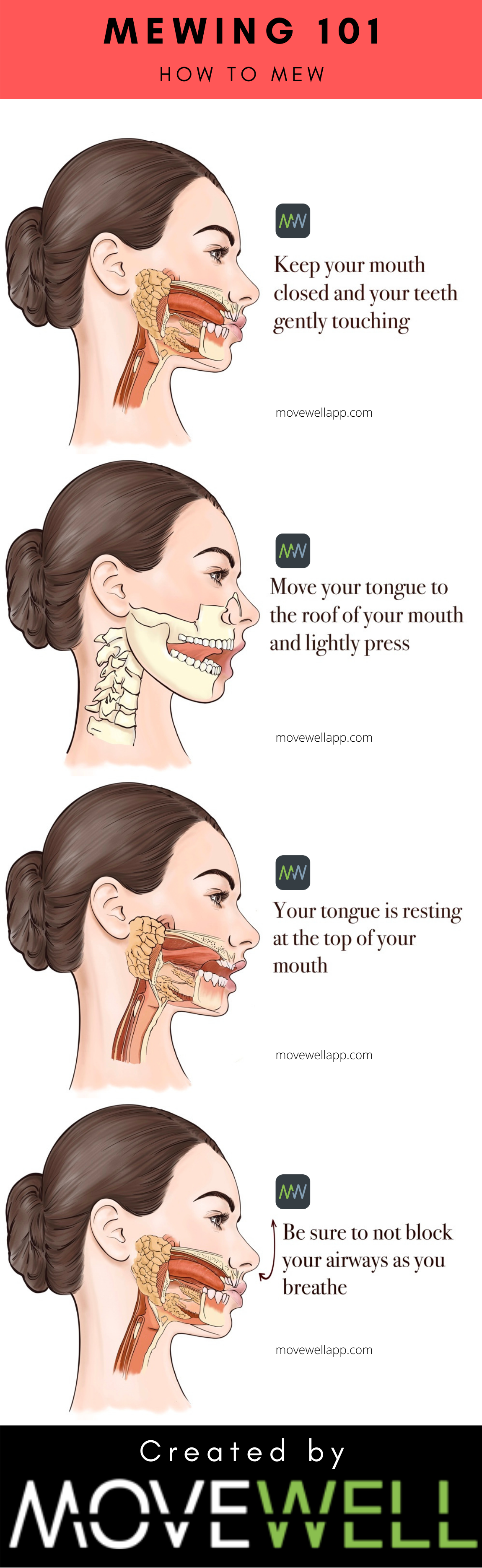
If you want to try a better resting tongue position, keep it gentle. This is a posture habit, not a jaw workout.
- Close your lips. Keep your jaw relaxed and don't clench your teeth.
- Place the tip of your tongue on the roof of your mouth, just behind your upper front teeth. It should not push against your teeth.
- Let the rest of your tongue rest lightly against the palate. Light contact is enough. You should not feel strain.
- Breathe through your nose.
- Check your tongue position a few times a day until it becomes a habit.
Our tongue posture guide has more detail. Posture elsewhere matters too, so see our guides to improving your posture and forward head posture.
Common mistakes
- Pressing hard. Light contact is enough. Stop if your teeth, jaw or face hurt.
- Pushing against your teeth. Constant tongue pressure on your teeth can move them.
- Pressing with only the tip. Rest the whole tongue without blocking your airway.
- Clenching. Keep your lips closed and your jaw relaxed.
- Breathing through your mouth. Aim to breathe through your nose.
- Expecting your face to change. There is no good evidence that it will.
Mewing and children
Don't use mewing or "hard mewing" to try to change how a child's face grows. Cleveland Clinic notes that mewing can move teeth, especially in children and teens. If you're worried about a child's bite, jaw or breathing, ask a dentist or orthodontist.
When to see a professional
- Jaw pain, or pain when you chew: see a dentist.
- Crooked teeth or bite problems: see an orthodontist. The AAO says orthodontic treatment is the safest and most effective way to address jaw misalignment.
- Snoring or feeling sleepy during the day: talk to a doctor about whether you need a sleep study.
- You can't breathe through your nose: see an ENT doctor to rule out a structural problem such as a deviated septum.
- You want a different jawline: ask an orthodontist or oral surgeon what is realistic.
Related guides
- Tongue posture 101
- Mouth tape and sleep
- Looksmaxxing: what's actually supported
- Jaw exercisers: do they work?
- Posture correctors
Frequently asked questions
Does mewing work?
Not for changing your face. We found no trial showing that mewing reshapes an adult's jaw, and the AAO and BOS say there is no evidence for it. A relaxed tongue posture with nose breathing is a reasonable habit on its own terms.
How long does mewing take to work?
There is no evidence that it changes your facial structure on any timescale. Online before and after photos are hard to judge, because lighting, shadows and head angle all change how a jaw looks.
Is mewing safe?
Light tongue contact with the palate is low risk. Pressing hard is not. The AAO warns that chronic pressure can loosen teeth, misalign your bite, wear teeth and affect speech.
Can mewing fix sleep apnea?
No. Sleep apnea needs a diagnosis and treatment from a doctor. Supervised myofunctional therapy has some evidence as an add-on to treatment, but that is a structured program, not mewing.
Who invented mewing?
It is named after British orthodontists John Mew and his son Mike Mew. Both were later erased from the UK dental register, John in 2017 and Mike in 2024.
Do chewing gum or jaw trainers help?
The BOS says there is no scientific evidence that chewing changes the shape of your face. Dentists writing in the British Dental Journal have warned that hard-resistance jaw trainers put extra stress on the jaw joint. See our jaw exerciser guide.
References
- American Association of Orthodontists: risks of mewing (news release, January 2024)
- British Orthodontic Society: claims about orthodontics (January 2024)
- Cleveland Clinic: does mewing work to reshape your jaw? (January 2025)
- Healthline: everything you need to know about the mewing craze (2019)
- Lee, Graves and Friedlander: mewing, social media's alternative to orthognathic surgery? Journal of Oral and Maxillofacial Surgery (2019)
- Myofunctional therapy to treat obstructive sleep apnea: a systematic review and meta-analysis. Sleep (2015)
- Xu and others: efficacy of myofunctional therapy for obstructive sleep apnea, a systematic review and network meta-analysis. Journal of Evidence-Based Dental Practice (2025)
- Harvard Mass Eye and Ear: mouth breathing vs nose breathing
- Wikipedia: John Mew
- GDPUK: John Mew (1928–2025), orthodontist and controversial figure in British dentistry (August 2025)
- Dentistry.co.uk: "mewing" dentist struck off (November 2024)
- Mew v General Dental Council [2026] EWHC 1116 (Admin), judgment of May 15, 2026
- Dr. Bicuspid: researchers warn of jaw training device (March 2021)