Muscle Scraping: What the Evidence Says and How to Do It
Muscle scraping (IASTM, Graston, gua sha) graded by outcome: pain, function, range of motion and recovery, plus how to do it safely at home and what a tool costs.
Last verified November 2, 2026. Every grade, study figure and price on this page links to the source we checked. Where we couldn't confirm something, we say so.
We have not tested these tools ourselves; specs and prices come from the pages cited below.
The short answer
Muscle scraping is low-risk if you go gently, and many people say it makes a tight area feel looser for a while. The research is weaker than the social media videos suggest. Early reviews of small trials were positive,2, 3 but the largest and most recent review, 46 randomized trials, found that adding scraping to other treatment made no meaningful difference to pain, function or range of motion, and rated the evidence as very low certainty.1 If you like how it feels, it's a reasonable add-on to exercise. Don't expect it to fix an injury on its own.
What muscle scraping is
Muscle scraping means stroking the skin over a muscle with a smooth-edged tool, usually steel, plastic or stone, after applying a lotion or gel so the tool glides. Clinicians call it instrument-assisted soft tissue mobilization, or IASTM. The Graston Technique is one branded IASTM method with its own tools and training; you can read more in our Graston guide. Gua sha is the traditional Chinese practice it resembles, where the skin is scraped until it reddens or small spots appear; see our gua sha guide.
Brands and clinicians offer several explanations for why it might help: more blood flow to the area, less tissue stiffness, release of fascia, or a change in how pain signals are processed.3 None of these has been shown to be the reason people feel better.
Video: how muscle scraping works
Joel recorded this short video guide for the original version of this page. It covers what muscle scraping is, how to do it and what to expect.
What the evidence says
A = consistent meta-analyses of randomized trials. B = a meta-analysis or several good trials with a moderate effect, in a narrower group. C = small effects, or small or few trials. D = too little evidence. X = tested, and the claimed effect did not show up.
| Claim | Grade | What the best evidence found | Caveat |
|---|---|---|---|
| Less pain in musculoskeletal conditions | C | Small reviews found pain fell in most IASTM groups.3, 4 The 2023 meta-analysis of 46 trials found no meaningful benefit when IASTM was added to other treatment, up to one year.1 | Very low certainty; high risk of bias |
| Better function | C | Same pattern: positive in early, smaller reviews;2 no meaningful added effect in the 2023 meta-analysis.1 | |
| More range of motion | C | Large effect sizes in uninjured people in a 2019 review of 12 trials;2 no clinically meaningful change in the 2023 meta-analysis.1 | Short-term measures |
| Chronic neck pain (gua sha) | C | One trial, 48 people: a single gua sha session cut pain by about 30 mm on a 100 mm scale at one week, compared with a heat pad.5 | Open-label, one week, one session |
| "Anti-inflammatory" effect | D | Gua sha raised an antioxidant enzyme (heme oxygenase-1) in mice.6 We found no human evidence that this matters. | Mouse methods paper |
| Faster recovery or better performance | D | We found no good evidence in the reviews we read. |
Why the reviews disagree: the earlier reviews pooled a handful of small trials, often comparing scraping with nothing. The 2023 review included many more trials and asked a stricter question: does scraping add anything to the treatment people would get anyway? It also warned that IASTM trials increasingly appear in suspected predatory journals, and that only 10 of 46 trials reported side effects.1
How to do it at home
- Pick one area that feels tight or sore, such as calves, quads, the IT band area or forearms. Avoid the front of the neck, the spine itself, and bony points.
- Apply a lotion, oil or the gel that comes with your tool. Use the tool only with a lubricant.8
- Hold the tool at a shallow angle and stroke in one direction along the muscle, with light to medium pressure.8
- Work for a minute or two per area, then move on. You don't need long sessions.
- Wait 24 to 48 hours before scraping the same muscle again, as the Sidekick guide advises.8
- Clean the tool after each use.8
It can feel mildly uncomfortable. It shouldn't be sharply painful.
Redness, bruising and the before-and-after photos
Redness afterward is normal and expected.8 Gua sha deliberately scrapes until small red or purple spots (petechiae) or bruises appear;6 you don't need to go that far for muscle scraping.
The dramatic before-and-after photos on social media mostly show that redness. Bright red or purple skin is not a sign of a better result, and the trials above didn't use it as one. If you regularly bruise or the skin breaks, you are pressing too hard; back off, or have it done by a physical therapist or other trained clinician.
Who should be careful
We didn't find a standard contraindication list in the sources we read, so these are precautions, not rules:
- Don't scrape over broken skin, rashes, burns, varicose veins, recent fractures or a swollen, hot area.
- Ask your doctor first if you take blood thinners, bruise easily, have a bleeding or clotting disorder, or have diabetes with reduced sensation.
- See a clinician rather than scraping it yourself if pain is severe, came on after an injury, or keeps getting worse.
Can you do it on yourself?
Yes, for the areas you can reach: legs, forearms, the front of the shoulder. Your own back and the back of your shoulders are hard to reach. A partner can help, or a physical therapist, chiropractor or massage therapist trained in IASTM can do it.
Tools and how we chose
We set these criteria before looking at tools. Commission is not one of them.
- Smooth, rounded edges that won't nick the skin.
- Easy to clean (stainless steel or hard plastic).
- A current product with a price we could check on November 2, 2026.
Some links on MoveWell earn us a commission. That played no part in which products are listed here or in what order.
Sidekick Echo
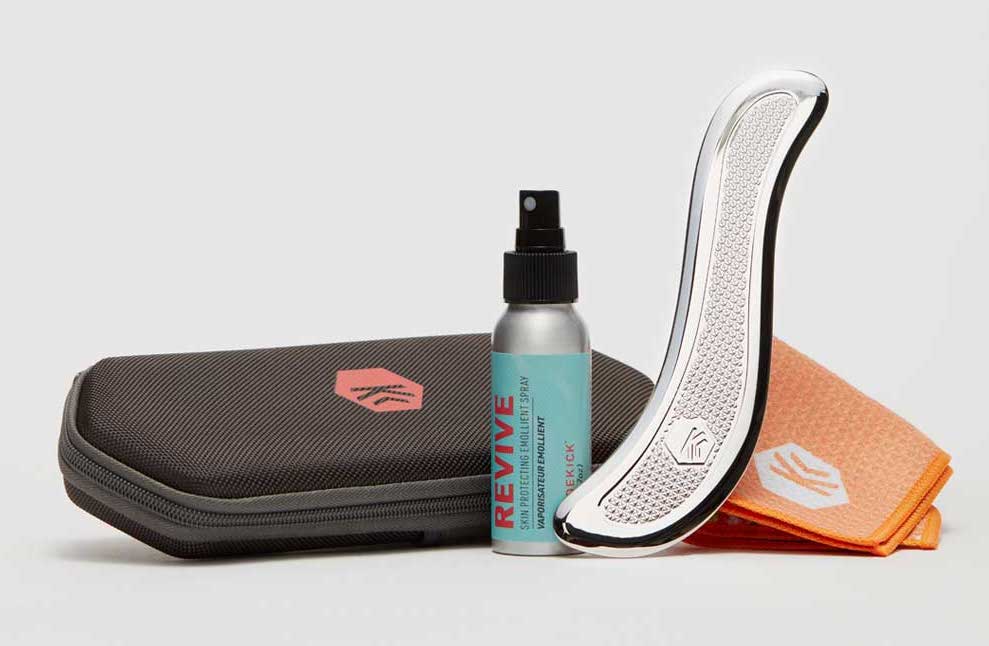
A stainless steel scraper, 8 in (20 cm) long, $95 on Sidekick's site when we checked; the shorter Eclipse is also $95 and the long Bow is $136.7 The Echo comes with Sidekick's Revive gel, and Rogue's product guide gives clear instructions on pressure, rest days and cleaning.8
Sidekick says its tools relieve pain "instantly", are "clinically proven", and boost blood circulation "by up to 400%".7 The independent reviews above don't support claims that strong.
Cheaper option
You don't need a branded tool to try it. Cheaper stainless steel or plastic scrapers do the same basic job; check that the edges are smooth and rounded. A smooth spoon edge is the traditional gua sha tool.6
FAQ
Does muscle scraping break up scar tissue or fascia?
That's a common explanation, but it hasn't been shown.3
How often should I do it?
Sidekick's guide suggests 24 to 48 hours between sessions on the same muscle group.8
Is muscle scraping the same as gua sha or Graston?
They're closely related. Graston is a branded clinical IASTM method; gua sha is the traditional practice. See our Graston and gua sha guides.
Is it better than foam rolling or a massage gun?
We found no good head-to-head trials. All three are ways to apply pressure to a muscle; pick the one you'll use. See foam rollers and massage guns.
Should it hurt?
Some discomfort is normal; sharp pain is not.8
Related: foam rolling guide, which recovery tools have evidence, IT band injury guide.
Featured photo by John Fornander on Unsplash.
References
- Nazari G, Bobos P, Lu S et al. Effectiveness of instrument-assisted soft tissue mobilization for the management of upper body, lower body, and spinal conditions: an updated systematic review with meta-analyses. Disabil Rehabil 2023;45(10):1608-1618. Source
- Seffrin CB, Cattano NM, Reed MA, Gardiner-Shires AM. Instrument-assisted soft tissue mobilization: a systematic review and effect-size analysis. J Athl Train 2019;54(7):808-821 (PEDro record). Source
- Lambert M, Hitchcock R, Lavallee K et al. The effects of instrument-assisted soft tissue mobilization compared to other interventions on pain and function: a systematic review. Phys Ther Rev 2017;22(1-2):76-85 (PEDro record). Source
- Karmali A, Walizada A, Stuber K. The efficacy of instrument-assisted soft tissue mobilization for musculoskeletal pain: a systematic review. J Contemp Chiropr 2019;2(1):25-33. Source
- Braun M, Schwickert M, Nielsen A et al. Effectiveness of traditional Chinese "gua sha" therapy in patients with chronic neck pain: a randomized controlled trial. Pain Med 2011;12(3):362-369 (abstract via BVS/MEDLINE). Source
- Kwong KK, Kloetzer L, Wong KK et al. Bioluminescence imaging of heme oxygenase-1 upregulation in the Gua Sha procedure. J Vis Exp 2009;(30):e1385. Source
- Sidekick. Eclipse Muscle Scraper product page, including the Echo in its size and price comparison (accessed 2 Nov 2026). Source
- Rogue Fitness. Product guide: Sidekick Echo Muscle Scraper (accessed 2 Nov 2026). Source