GHK-Cu
Also called copper tripeptide-1, prezatide copper, copper peptide
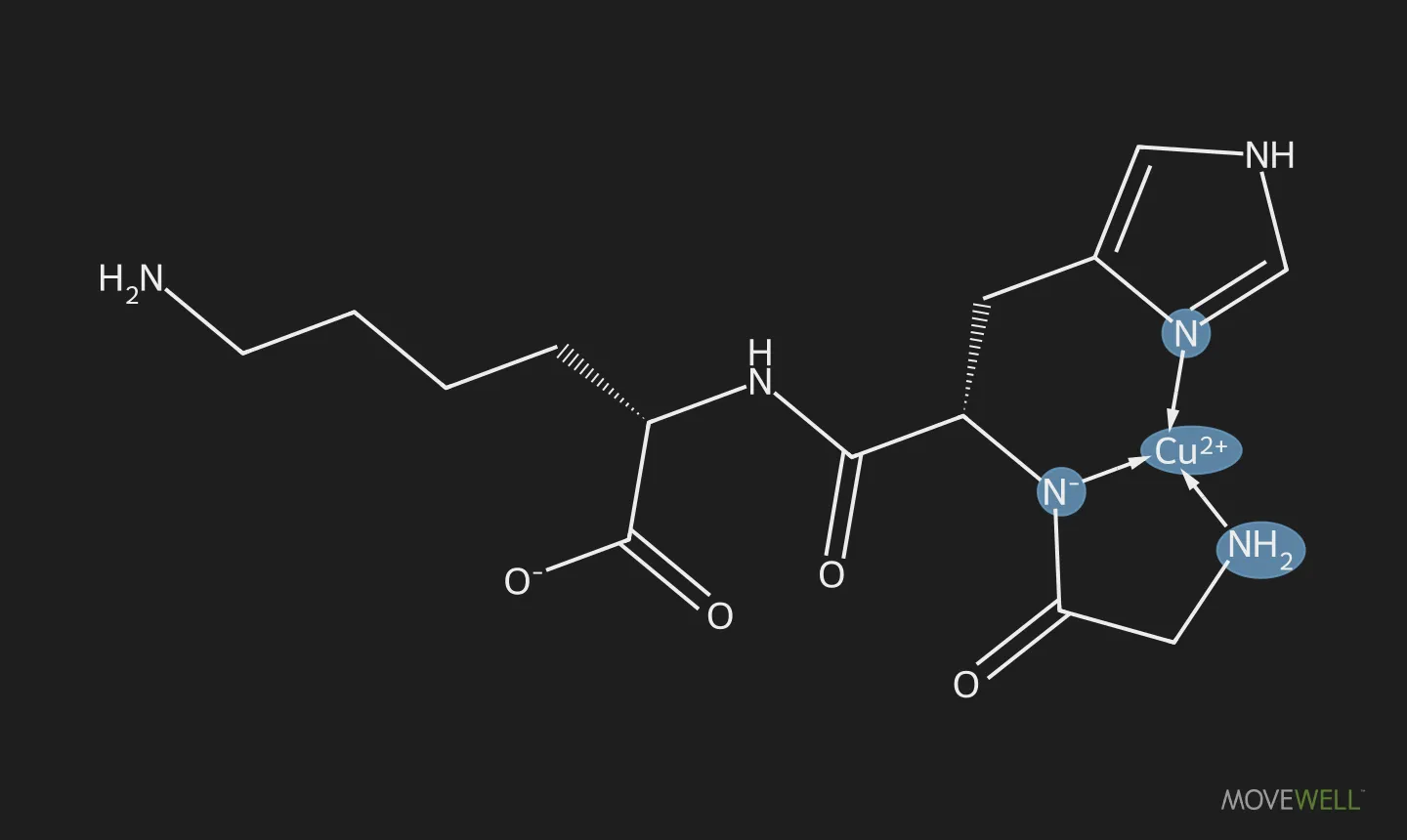
GHK-Cu is a three-amino-acid peptide that carries a copper ion. On skin, one published trial and several industry studies show modest gains in wrinkles and firmness over 8 to 12 weeks. For hair, the only GHK-Cu trial we found is one small eyebrow study. Claims for injury recovery and injected "whole-body" use rest on lab and animal work only.
Related copper peptide: AHK-Cu, the one actually tested in the hair study people cite for GHK-Cu
In this guide
At a glance
| What it is | Glycine–histidine–lysine bound to one copper ion; occurs naturally in human blood |
|---|---|
| Sold as | Cosmetic serums and creams (label name: copper tripeptide-1); compounded prescription creams |
| Best evidence | Topical skin aging (1 published RCT, n=40) and diabetic foot ulcers (1 RCT, 1994) |
| No human evidence for | Scalp-hair growth with GHK-Cu itself (one trial used a copper-free GHK complex; the only GHK-Cu hair trial we found was a small eyebrow study), tendon or ligament healing, injected use of any kind |
| Time to results | Skin trials measured at 8 to 12 weeks |
| Main risks | Skin irritation (topical). Unknown for injection, which FDA flags for immune reactions and impurities |
| Typical cost | $23 to $69 for a cosmetic serum; from $55 per 30 g for compounded creams |
Where to get it
MoveWell sells no peptides. All options and prices
Pick one that discloses its strength. Neurogan and Peach & Lily state theirs; many don't.
Compare 8 serumsSuperpower, Enhanced and Trinova offer GHK-Cu creams after a clinician review, from $55 per 30 g.
Compare providersNo legal compounding path and no human data. "Research use only" vials aren't tested for people.
WhyMolecular structure
Three amino acids folded around one copper ion, held by three nitrogens. That copper is why GHK-Cu solutions are blue.
Copper and the three nitrogens that bind it
The GHK peptide alone, without copper. Drag to rotate
- Sequence
- Gly-His-Lys
- Formula
- C14H22CuN6O4
- Weight
- ≈401.9 g/mol
- Peptide alone
- C14H24N6O4, 340.4 g/mol
- CAS
- 89030-95-5
- FDA UNII
- 6BJQ43T1I9
- PubChem
- 10111685 · GHK 73587
- EU CosIng
- Ref 55687
Drawn from the FDA-registered form of prezatide copper; weight calculated from the formula.28
What it is
Loren Pickart first isolated GHK from human blood in 1973, while studying why serum from younger people helped liver cells survive.1 Its sequence was confirmed as glycine-histidine-lysine in 1977,2 and in 1980 his group showed it binds copper tightly and helps move copper into cells.3
The same sequence sits inside type I collagen, and one theory holds that it is released when collagen breaks down at a wound, acting as a repair signal.6 Pickart's reviews report blood levels of about 200 ng/mL at age 20 falling to about 80 ng/mL by 60, though they cite no original measurement.4
Commercial GHK-Cu is made synthetically, not extracted from blood. A close cousin, AHK-Cu, swaps glycine for alanine and is sold mainly for hair.
How it works
Almost everything known about the mechanism comes from cell cultures and rats.
- Collagen. In skin cells, collagen production started rising at vanishingly low doses and peaked around one nanomolar.6 In lab and animal work it built up collagen and glycosaminoglycans.7, 8
- Remodeling. It shifts the enzymes that break down and rebuild tissue (MMP-2, MMP-9) and their inhibitors.9, 10
- Copper delivery. Enzymes that cross-link collagen and neutralize free radicals need copper; GHK carries it in a form that can't cause oxidative damage.3, 5
- Gene activity. A reanalysis of a public database of drug effects on cancer cell lines found GHK changed about 31% of genes by at least 50%.4 That is a computational result from cell lines, not a measurement in human tissue.
Evidence map
Each claimed use is graded separately, because the evidence differs sharply by use.
Limited human: 1 published RCT (n=40) plus conference abstracts
Limited human: 1 diabetic ulcer RCT (1994); a 60-person trial is recruiting
Animal only: 1 rat study, benefit gone by 12 weeks
Animal and lab only: no human study of any injected dose
Scale: 5 FDA-approved, 4 strong human, 3 limited human, 2 animal or lab only, 1 anecdotal
Key studies
| Use | Study | Model | Finding |
|---|---|---|---|
| Skin | Badenhorst 201611 | Human RCT n=40 | Wrinkle volume −55.8% vs plain serum at 8 weeks; also beat Matrixyl 3000 |
| Skin | Leyden 200212 | Human n=71, 41 | Face and eye creams improved fine lines and density over 12 weeks (conference abstracts) |
| Skin | Finkley 200512 | Human n=67 | Firmness, lines and pigmentation improved at 12 weeks (book chapter) |
| Skin | Abdulghani 199812 | Human biopsy | Collagen rose in 70% of sites vs 50% for vitamin C and 40% for retinoic acid (small, not fully peer-reviewed) |
| Wound | Mulder 199413 | Human RCT diabetic ulcers | Median closure 98.5% vs 60.8%; infection 7% vs 34% |
| Wound | NCT0743758614 | Human RCT n=60 | 0.1% gel on acute wounds; recruiting, no results yet |
| Wound | Maquart 19938 | Rat | More collagen and tissue in wound chambers |
| Ligament | Fu 201516 | Rat n=72 | Knee injections after ACL repair: less laxity at 6 weeks, none by 12; graft strength unchanged |
| Lung | Park 201617 | Mouse | Less lung inflammation in an induced-injury model |
| Lung | Campbell 201218 | Lab lung cells | Restored repair behavior in cells from emphysema patients |
| Nerve | Ahmed 200519 | Rat | More nerve growth factors and axons in collagen nerve tubes |
| Hair | Pyo 200715 | Lab scalp follicles | Follicles grew longer, but with AHK-Cu, not GHK-Cu |
| Hair | Bo 202633 | Human RCT n=18, split-face | 2% serum on one eyebrow, placebo on the other, for 12 weeks: hair count rose significantly from baseline on the treated side only. Eyebrows, not scalp |
Much of the human skin evidence was run or funded by industry, and the main reviews come from the discoverer's own group.4, 5
Topical or injectable
Pick your goal to see what the evidence supports.
| Topical | Injectable | |
|---|---|---|
| Legal status | Cosmetic; compounding allowed under Category 1 | No FDA compounding path; sold mostly as "research use only" |
| Human evidence | Small trials for skin and wounds | None |
| Where it acts | Skin where applied | Claimed whole-body; unproven |
| Known risks | Irritation | Unknown; FDA cites immune reactions and impurities |
| Cost | $23 to $69 per bottle; from $55 per 30 g compounded | No legal source to price |
How it's used
Topical
Serums and creams are applied once or twice a day. The skin trials ran 8 to 12 weeks, so judge results at that point, not after a few days.11, 12
Labeled strength is hard to compare. Products state anywhere from 0.1% to 4%, and "1%" often means 1% of a raw-material solution, not pure peptide. The safety panel noted cosmetic use is typically below 10 parts per million.20
Injectable
No human study has tested any injected dose. Clinics and online guides describe protocols such as 1 to 3 mg under the skin two or three times a week in 8- to 12-week cycles; those numbers come from practice, not trials.27 Even the discoverer's own reviews suggest human doses that differ by several thousand times, from about 35 µg to 100–200 mg.4, 5 We report these as information, not instruction.
Side effects and who should avoid it
- Topical. The Cosmetic Ingredient Review panel found it safe as used in cosmetics.20 Mild irritation or redness is the usual complaint.
- Injectable. FDA says compounded injectable GHK-Cu may trigger immune reactions from aggregation and impurities, and human safety data are limited.21 Gray-market vials add contamination and dosing risks.
- Copper disorders. People with Wilson's disease or a copper allergy are usually told to avoid it. This is a precaution; it has not been studied.
- Cancer. GHK promotes blood-vessel growth and was first noted for stimulating liver tumor cells in culture;1 other lab work suggests anti-tumor gene effects.4 No clinical data exist either way. Anyone with active cancer should ask their oncologist.
- Pregnancy and breastfeeding. No data.
Compared with
| GHK-Cu | AHK-Cu | Tretinoin | Matrixyl | |
|---|---|---|---|---|
| Status | Cosmetic | Cosmetic | Prescription drug | Cosmetic |
| Main use | Skin | Hair | Wrinkles, acne | Skin |
| Human evidence | Limited | None found | Strongest | Small cosmetic trials |
| Irritation | Low | Low | Common at first | Low |
GHK-Cu beat Matrixyl 3000 on wrinkle volume in one RCT;11 one small biopsy study found more new collagen than with vitamin C or retinoic acid.12
Stacks
Only one GHK-Cu combination has been tested, and it disappointed. The rest are untested.
GLOW
Marketing onlyNo study of the blend. Pre-mixed vials fall outside the Oct 2026 compounding policy, and injectable GHK-Cu has no path at all.
KLOW
Marketing onlySame as GLOW. Under the 2026 policy KPV is allowed only topically or by mouth.
GHK-Cu + microneedling
Tested, smallOne non-randomized trial (n=40, acne scars): the copper group scored worse at baseline and week 3 and was no different from needling alone from week 6 on, with and dark spots in 8 of 20 vs 0 of 20, which faded later.31 Cosmetic serums also aren't sterile products made to go under the skin.
GHK-Cu + red light
Marketing onlyThe most-shared article promoting it cites no studies. See our red light therapy guide.
Myths vs evidence
All options and prices
MoveWell sells no peptides. Prescription options first, then cosmetics by disclosed strength. Prices checked Oct–Nov 2026
Compounded prescription creams
| Provider | Form | Price | Consult |
|---|---|---|---|
| Superpower | 0.5% GHK-Cu cream | Members only ($17/mo membership); product price not shown | Questionnaire and physician review |
| Enhanced | Cream, up to 10 mg per application | Price not published | Clinician consult |
| Trinova Health | Multi-ingredient cream with GHK-Cu | From $55 per 30 g | Online evaluation |
Over-the-counter cosmetics
| Product | Stated strength | Size | Price |
|---|---|---|---|
| Neurogan GHK-Cu Hair & Scalp Serum | "4%" (2,400 mg per bottle) | 60 mL | $60 |
| Neurogan GHK-Cu Face & Neck Serum | "4%" (1,200 mg) | 30 mL | $45 |
| NIOD Copper Amino Isolate Serum 3 | Not on label (third-party estimate 4–5%) | 15 / 30 mL | To confirm |
| The Ordinary Multi-Peptide + Copper Peptides 1% | "1%" (undefined) | 30 mL | $32 |
| Peach & Lily Copper Peptide Pro Firming Serum | 0.2% | 30 mL | $49 |
| Good Molecules Copper Peptide Serum | 0.1% | 30 mL | To confirm |
| Biossance Squalane + Copper Peptide Serum | Not disclosed | 50 mL | $69 |
| Provence Beauty Dew Beaucoup Copper Peptide Serum | Not disclosed | 30 mL | $23 |
Left off: products sold as "copper peptides" that contain other copper compounds (one popular serum uses soy protein plus copper chloride), and Drunk Elephant Protini and Medik8 Copper PCA, which contain no GHK-Cu
Injectable GHK-Cu
There's no FDA compounding path for injectable GHK-Cu, so we don't list sellers. Vials sold "for research use only" aren't tested for human use; in August 2026 FDA warned sellers that the label doesn't excuse products clearly meant for people.30
Legal status history
Newest first. Topical and injectable GHK-Cu are regulated separately.
- FDA's Pharmacy Compounding Advisory Committee reviews injectable GHK-Cu, with LL-37, dihexa, PEG-MGF and melanotan II. Date not published.25
- Current statusTopical GHK-Cu: cosmetic, and in FDA Category 1, which lets licensed 503A pharmacies compound it under conditions. Injectable GHK-Cu: no category, no compounding path.23, 24
- HHS enforcement discretion for six other peptides (BPC-157, TB-500, KPV, MOTS-c, semax, epitalon), single-ingredient only. GHK-Cu not included; blends like GLOW excluded.26
- Advisory committee backs those six for compounding. GHK-Cu was not on the agenda.
- Non-injectable GHK-Cu put back in Category 1, after a nominator clarified on May 5 that it had withdrawn only the injectable route.23
- Injectable GHK-Cu removed from Category 2 and non-injectable from Category 1 after nominations were withdrawn.23
- Injectable GHK-Cu placed in Category 2 (possible significant safety risks); non-injectable in Category 1.22
- Cosmetic Ingredient Review panel finds copper tripeptide-1 safe in cosmetics at current concentrations.20
GHK-Cu is not FDA-approved as a drug for any use. In the EU it is a listed cosmetic ingredient with no restrictions.29
FAQ
Does topical GHK-Cu work?
Modestly, on the evidence available. One 40-person randomized trial found less wrinkle volume after 8 weeks, and older industry studies point the same way. Prescription tretinoin is better proven.
Why is GHK-Cu blue?
The copper ion. Copper(II) complexes absorb red-orange light, so solutions and powders look blue. A product that isn't blue may contain very little GHK-Cu or a different copper compound.
Can I use it with vitamin C or acids?
Skincare guides often say to separate them because acids and vitamin C may destabilize the copper complex. We found no study testing whether it matters on skin. Using them at different times of day avoids the question.
Does it help hair loss?
We found no scalp-hair trial of GHK-Cu. The often-cited hair study tested AHK-Cu. One small 2026 randomized, double-blind, split-face trial (n=18) of a 2% GHK-Cu serum on the eyebrows reported a significant rise in hair count from baseline on the treated side at 12 weeks, with no significant change on the placebo side. Minoxidil and finasteride have the evidence for hair loss.
Is GHK-Cu legal?
Yes as a cosmetic, and pharmacies can compound topical versions. Injectable GHK-Cu has no compounding path. FDA's advisory committee reviews it by February 2027, but a vote alone doesn't create one; that takes a rule or a policy like the October 2026 HHS one.
How long until I see results?
The skin trials measured results at 8 to 12 weeks of daily use.
Is it safe?
Topically, a safety panel found it safe at cosmetic concentrations. Injected, nobody knows; there are no human safety data.
Is it the same as copper tripeptide-1?
Yes. Copper tripeptide-1 is the ingredient name on cosmetic labels.
What's the difference between GHK-Cu and AHK-Cu?
One amino acid: AHK-Cu has alanine where GHK-Cu has glycine. AHK-Cu is marketed for hair; see our AHK-Cu guide.
What does BPC-157 have to do with it?
They're often sold together in GLOW blends. The blend has never been studied, and pre-mixed vials fall outside FDA's 2026 compounding policy.
References
33 sources, with links
- Pickart L, Thaler MM. Tripeptide in human serum which prolongs survival of normal liver cells and stimulates growth in neoplastic liver. Nature New Biology 1973;243:85–87. Record
- Schlesinger DH, Pickart L, Thaler MM. Growth-modulating serum tripeptide is glycyl-histidyl-lysine. Experientia 1977;33:324–5. PMID 858356
- Pickart L et al. Growth-modulating plasma tripeptide may function by facilitating copper uptake into cells. Nature 1980;288:715–717. Link
- Pickart L, Margolina A. Regenerative and protective actions of the GHK-Cu peptide in the light of the new gene data. Int J Mol Sci 2018;19:1987. DOI 10.3390/ijms19071987
- Pickart L, Vasquez-Soltero JM, Margolina A. GHK peptide as a natural modulator of multiple cellular pathways in skin regeneration. BioMed Res Int 2015:648108. PMC4508379
- Maquart FX et al. Stimulation of collagen synthesis in fibroblast cultures by the tripeptide-copper complex GHK-Cu. FEBS Lett 1988;238:343–6. DOI
- Wegrowski Y et al. Stimulation of sulfated glycosaminoglycan synthesis by GHK-Cu. Life Sci 1992;51:1049–56. DOI
- Maquart FX et al. In vivo stimulation of connective tissue accumulation by GHK-Cu in rat experimental wounds. J Clin Invest 1993;92:2368–76. PMC288419
- Siméon A et al. Expression and activation of matrix metalloproteinases in wounds: modulation by GHK-Cu. J Invest Dermatol 1999;112:957–64. PMID 10383745
- Siméon A et al. Fibroblast–cytokine–extracellular matrix interactions in wound repair. Life Sci 2000;67:2257–65. PMID 11045606
- Badenhorst T et al. Effects of GHK-Cu on MMP and TIMP expression, collagen and elastin production, and facial wrinkle parameters. J Aging Sci 2016;4:166. DOI 10.4172/2329-8847.1000166
- Leyden J et al. (AAD 2002 abstracts); Abdulghani A et al. (1998); Finkley M et al. (2005), as described in reference 5. Not peer-reviewed full papers.
- Mulder GD et al. Enhanced healing of ulcers in patients with diabetes by topical treatment with glycyl-l-histidyl-l-lysine copper. Wound Repair Regen 1994;2:259–69. DOI
- Topical GHK-Cu Gel for Acute Skin Wound Healing. NCT07437586
- Pyo HK et al. The effect of tripeptide-copper complex on human hair growth in vitro. Arch Pharm Res 2007;30:834–9. DOI (tested AHK-Cu)
- Fu SC et al. Tripeptide-copper complex GHK-Cu (II) transiently improved healing outcome in a rat model of ACL reconstruction. J Orthop Res 2015. DOI 10.1002/jor.22831
- Park JR et al. The tripeptide GHK-Cu complex ameliorates lipopolysaccharide-induced acute lung injury in mice. Oncotarget 2016;7:58405–17. DOI
- Campbell JD et al. A gene expression signature of emphysema-related lung destruction and its reversal by the tripeptide GHK. Genome Med 2012;4:67. DOI
- Ahmed MR et al. Effect of GHK-Cu incorporated collagen nerve tubes on peripheral nerve regeneration in rats. J Peripher Nerv Syst 2005;10:17–30, as described in reference 4.
- Johnson W et al. Safety assessment of tripeptide-1, hexapeptide-12, their metal salts and fatty acyl derivatives, and palmitoyl tetrapeptide-7 as used in cosmetics. Int J Toxicol 2018;37(3 suppl):90S–102S. DOI
- FDA. Certain bulk drug substances for use in compounding that may present significant safety risks. fda.gov
- FDA 503A categories update, September 2023 (copy via A4PC). PDF
- FDA. Bulk drug substances nominated for use in compounding under 503A, categories list (updated May 14, 2026). fda.gov
- FDA. Bulk drug substances used in compounding under section 503A. fda.gov
- FDA. Meeting of the Pharmacy Compounding Advisory Committee (before end of Feb 2027). fda.gov
- BakerHostetler. HHS issues enforcement discretion policy regarding 503A compounding using certain peptide bulk drug substances (Oct 2026). Link
- Healing Maps. GHK-Cu: The 2026 copper peptide guide (reported clinic protocols). Link
- FDA GSRS. Prezatide copper, UNII 6BJQ43T1I9. Link
- EU CosIng, copper tripeptide-1, ref 55687 (via mirror). Link
- Holland & Knight. Peptides at a crossroads: what wellness providers need to know (Oct 2026). Link
- Vignesh NR et al. A study comparing the effect of dermaroller versus dermaroller with copper peptide in the management of acne scars. J Cutan Aesthet Surg 2026;19(2):149–57. DOI 10.25259/JCAS_56_2025
- Lee WJ et al. Efficacy of a complex containing GHK and 5-aminolevulinic acid on hair growth in men with androgenetic alopecia. Ann Dermatol 2016. Copper-free; tests a different product.
- Bo SL, Nararatwanchai T, Suppornpun N, Poomarapan K, Thaploka S. The efficacy of 2% copper peptide (GHK-Cu) serum for eyebrow hypotrichosis (vehicle-controlled, split-face). Procedia of Multidisciplinary Research 2026;4(5). Link
This page is for education and is not medical advice. GHK-Cu is not FDA-approved as a drug. Talk to a clinician before using any peptide, especially by injection.