BPC-157
Also called Body Protection Compound-157, Bepecin, PL 147361
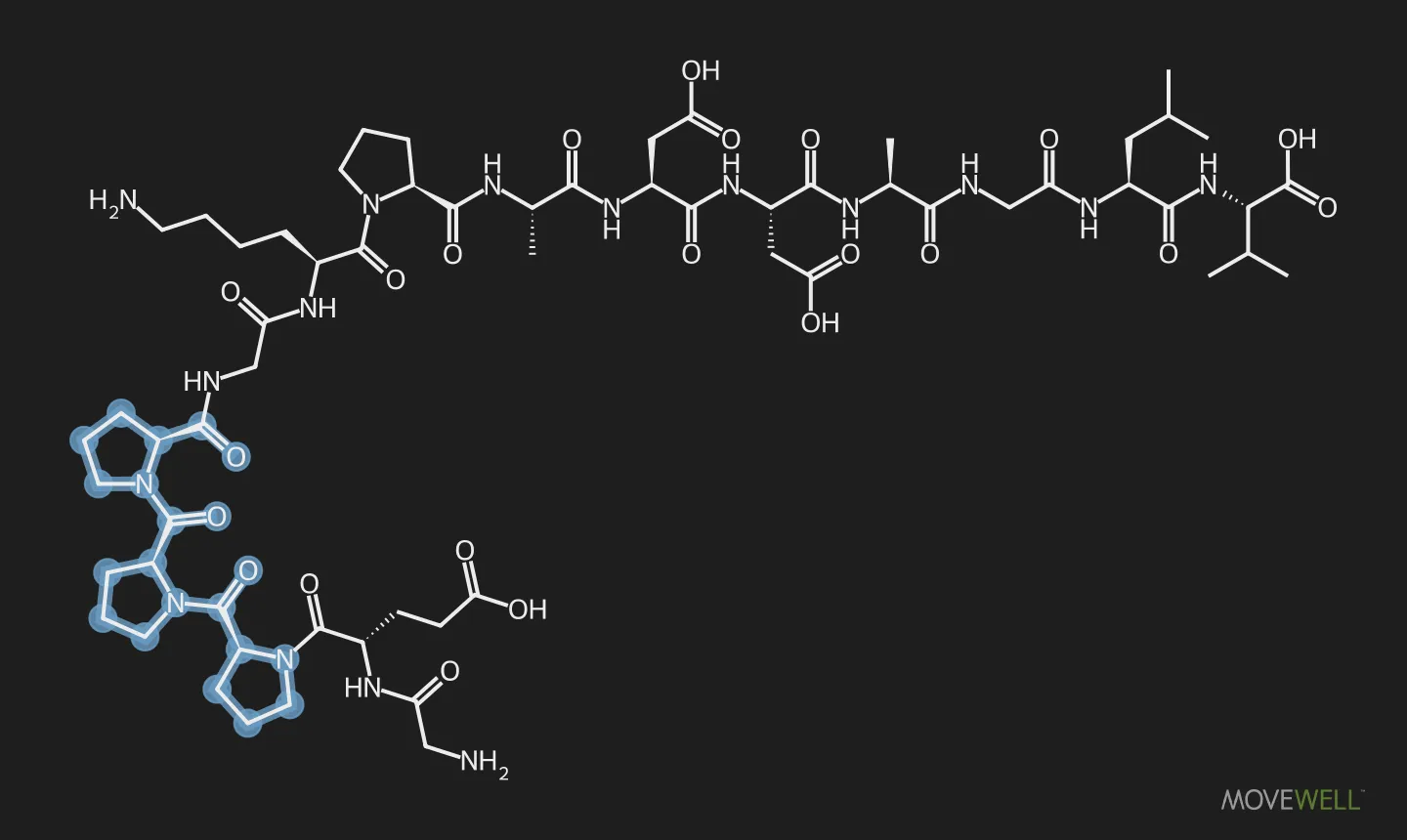
BPC-157 is a synthetic chain of 15 amino acids. Almost all the evidence comes from rats, mostly from one lab group. FDA found 5 small human studies. None tested injection under the skin, the way most people use it, and none showed a clear benefit.1 Since October 28, 2026, HHS has said it won't take action against licensed pharmacies that compound it with a prescription. It is still not FDA-approved or on the official compounding list.8
Often paired with TB-500. See BPC-157 vs TB-500
In this guide
At a glance
| What it is | A synthetic 15-amino-acid fragment of a protein first isolated from human gastric juice1 |
|---|---|
| Forms | Free base and acetate salt. FDA treats them as different substances. The HHS policy covers only the acetate1, 3 |
| Best evidence | Rat studies of tendon healing, gut injury and drug-induced stomach damage1 |
| Human evidence | 5 small studies. The one randomized trial (ulcerative colitis, by enema) found no significant difference from placebo1 |
| No human evidence for | Injection under the skin, oral use, tendon or muscle healing |
| Legal status | Acetate can be compounded with a prescription under HHS enforcement discretion. Not FDA-approved8, 22 |
| In sport | Banned at all times (WADA S0)12, 13 |
| Main risks | Unknown in people. FDA cites immune reactions and impurities. A 28-day animal study showed clotting and liver changes1 |
| Typical cost | $149 a month for a compounded injection (pre-order)25 |
Where to get it
MoveWell sells no peptides. All options and prices
BPC-157 injection pre-order at $149 a month. Needs a clinician review and prescription. Shipping targeted for late November.25
See all optionsTesting BPC-157 in its own facility. No price or launch date yet.26, 27
Check statusMolecular structure
A straight chain of 15 amino acids with no ring or metal. Three prolines in a row sit near the start.
The three prolines (Pro-Pro-Pro)
- Sequence
- GEPPPGKPADDAGLV
- Length
- 15 amino acids
- Formula
- C62H98N16O22
- Weight
- 1419.5 g/mol
- Acetate
- C62H98N16O22 · x(C2H4O2)
- CAS
- 137525-51-0 (free base) · 216441-37-1 (acetate)
- FDA UNII
- 8ED8NXK95P (free base) · PAR2FC72XP (acetate)
Drawn from the sequence FDA lists. Formula and weight are for the free base, as given by FDA and HHS.1, 3
What it is
FDA describes BPC-157 as "a pentadecapeptide fragment of the BPC protein originally isolated from human gastric juice." It was first made in a lab by researchers at the University of Zagreb in the early 1990s.1 The name is a common name, not an official drug name.1
What's sold is synthetic, not taken from stomach juice. FDA found products sold as "BPC-157" in several salt forms and called both the free base and the acetate "not well-characterized."1, 2 An "arginate" salt is sold as a "stable" or oral form. It doesn't appear in any FDA or HHS document we reviewed, and the HHS policy names only the acetate.3
How it works
No one knows for sure. FDA says its "mechanisms of action remain poorly understood," its molecular targets "have not been identified," and dose-response "relationships… have not been established."1
- Blood vessel growth. Animal papers propose it helps healing by growing new blood vessels.1
- Growth factor receptors. Papers also propose it raises growth-factor receptors.1
- Nitric oxide. A third proposed route runs through nitric oxide signaling.1
These are hypotheses from animal and lab work, not measured effects in people.
Evidence map
Each claimed use is graded separately, because the evidence differs by use.
Animal only: rat studies, mostly from one group. An independent 2026 rat study found no significant effect of BPC-157 alone
Animal data. The one human colitis trial found no significant difference from placebo
One uncontrolled chart review of knee injections (FDA counts 17 patients), with no comparison group
Rodent models only
One uncontrolled case series of 12. FDA did not report its results in detail
Scale: 5 FDA-approved, 4 strong human, 3 limited human, 2 animal or lab only, 1 anecdotal
Key studies
| Use | Study | Model | Finding |
|---|---|---|---|
| Colitis | Ruenzi 20051 | Human RCT n=53 | 80 mg enema daily for 2 weeks. No significant difference from placebo (46 completed) |
| Absorption | Veljaca 2002, 20031 | Human n=24, healthy | Enema up to 2 mg/kg for 8 days. Mostly undetectable in the blood |
| Knee | Lee & Padgett 20211 | Human chart review FDA counts 17 | 2 to 4 mg into the knee, 1 or 2 doses. Some also got thymosin β4. No control group |
| Bladder | Lee 20241 | Human case series n=12 | 10 mg into the bladder wall, once. Results not detailed by FDA |
| Safety | Lee & Burgess 20251 | Human pilot n=2 | 10 mg IV, then 20 mg IV. No serious side effects |
| Oral | NCT026372841, 6 | Registered planned n=42 | Oral doses vs placebo in healthy people. No results posted; FDA found no publication |
| Tendon | Biçer 20265 | Rat n=32 | BPC-157 alone was better on paper but not significantly. TB-500 alone was significant |
| Tendon | Staresinic 2003; Sikirić 20161 | Rat | Faster healing of cut tendons |
| Fistula | Klicek 20081 | Rat | Bowel-to-skin fistulas about 40% smaller from day 3 and closed by day 28. No tissue analysis |
| Stomach | Sikirić 19971 | Rat | Aspirin, diclofenac and indomethacin lesions cut by more than 75%, judged by eye |
| Liver | Sikirić 19931 | Rat | Prevented liver damage in toxin and stress models when given beforehand |
| Nerve | Sikirić 2011; Vukojević 20221 | Rodent | Protective effects in stroke and spinal cord injury models |
Most animal papers in FDA's review come from one Zagreb group (Sikirić, Seiwerth and colleagues). FDA does not comment on this.1 A 2026 scoping review found 67% of the sports-medicine peptide literature was preclinical.11 No human study tested injection under the skin.1
By goal and route
Pick your goal to see what the evidence supports.
| Injection | Oral | Topical | |
|---|---|---|---|
| HHS policy | Covered, under the skin or into muscle, acetate only | Covered, acetate only, with documented human bioavailability | Covered, acetate only |
| Human evidence | None under the skin. Knee and IV studies only | One trial registered, no results | None |
| Known risks | FDA cites immune reactions and impurities. All 3 FDA reports involve injections | Unknown | Unknown |
| Cost | $149 a month (pre-order) | Waitlist, no price | No listing found |
Sources: HHS policy terms,3, 23 FDA briefing,1 Superpower pricing.25
How it's used
No human study has worked out a dose for any route people actually use. How the body handles it by mouth, under the skin, in the nose or on the skin is unknown in humans.1, 2
Doses in the human studies
These were milligram doses given by routes few people use: 80 mg a day by enema, 2 to 4 mg into the knee, 10 mg into the bladder, and 10 to 20 mg IV.1
Doses in animals
Rat studies usually used 10 ng/kg or 10 µg/kg, mostly by injection into the belly or in drinking water.1, 5 Per-kilogram human regimens seen online appear to be scaled from these. We found no source that tests them.
In animals it clears fast. Half-life after IV dosing was 5.3 minutes in dogs and 15.2 minutes in rats. About 18% of an injected-into-muscle dose reached the blood in rats, and about 39% in dogs.1 We report these as information, not instruction.
Side effects and who should avoid it
- Immune reactions. FDA says that given by injection or nose, it "may pose a significant risk for immunogenicity, potentially amplified by aggregation." No immune-response studies exist.1
- Impurities. Certificates the nominators gave FDA listed 97.8% and 98.34% purity but named no impurities and showed no endotoxin or sterility testing.1
- Animal toxicology. A 28-day study in rats and dogs, injected into muscle, showed changes in a clotting test (aPTT) and liver signals: ALT, triglycerides, glucose and liver weight. Tissue results were not published. Genetic toxicity tests were negative.1
- Cancer. This is a theoretical concern, not an FDA finding. BPC-157 is thought to work partly by growing blood vessels, which some worry could help tumors. FDA did not raise this as a safety signal. It said no studies exist to judge cancer risk.1
- Reported side effects. FDA found 3 reports in its adverse event database (FAERS), all with injected products. FDA said it was unclear whether BPC-157 caused the events. They describe injection-site reactions, shortness of breath needing an ER visit, and darkened skin and gums. One involved a BPC-157 + TB-500 "research purposes only" product.1, 2 In the trials, headache and gas were most common, with no serious events.1
- Gray-market vials. We found no published test of BPC-157 sold online. "Research use only" products carry no identity, strength or sterility checks.
- Athletes. Prohibited at all times under WADA S0. The HHS policy doesn't change that.12, 13
- Pregnancy and breastfeeding. No human data.
Compared with
| BPC-157 | TB-500 | |
|---|---|---|
| What it is | 15-amino-acid fragment of a gastric juice protein | Synthetic fragment of thymosin β4 |
| Human evidence | 5 small studies, no clear benefit | Less. Human trials used full-length thymosin β4 |
| Rat Achilles study, 2026 | Not significant | Significant |
| PCAC vote, Jul 2026 | 8–6–1 | 8–6–1 |
| HHS routes | Under the skin, muscle, oral, topical | Under the skin, muscle |
Sources: Biçer 2026,5 Superpower guide,7 FDA Law Blog,9 HHS Appendix B.3 Full comparison: BPC-157 vs TB-500
Stacks
Only one BPC-157 combination has been tested, in rats, and it added nothing. All blends fall outside the HHS policy.
Wolverine
Rats onlyNo human data. A 2026 rat Achilles study (Biçer, n=32) found the combination gave no added benefit over either alone. TB-500 alone was the only group with a significant gain in tendon strength; the combination improved one tissue score.5 The HHS policy allows one active ingredient, so blends are excluded.3, 23
GLOW
Marketing onlyNo human or animal study of the blend. Doses and ratios vary by seller.7 Excluded as a blend.
KLOW
Marketing onlySame as GLOW. Under the HHS policy KPV is allowed only on the skin or by mouth.3
BPC-157 + GLP-1 drugs
No dataPromoted for GLP-1 stomach side effects. We found no study. FDA's briefing doesn't mention GLP-1 drugs.1
Myths vs evidence
All options and prices
MoveWell sells no peptides. Options inside the HHS policy first. Prices checked Oct–Nov 2026
Licensed compounding, with a prescription
BPC-157 injection pre-order at $149 a month. Needs a clinician review and prescription. Shipping targeted for late November.25
See Superpower| Provider | Form | Price | Status |
|---|---|---|---|
| Superpower | BPC-157 injection | $149 a month | Pre-order. Clinician review and prescription, US-licensed pharmacy, full refund if not approved. Ships late November25 |
| Superpower | Oral BPC-157 | Not listed | Waitlist25 |
| Hims & Hers | Not announced | Not listed | Running stability and validation testing. Said in August it was waiting on final FDA rules. No launch confirmed26, 27 |
Compounded drugs are generally not covered by insurance.10
Blends, outside the policy
| Provider | Product | Price | Status |
|---|
Research use only vials
The HHS policy excludes research chemicals, so we don't list sellers.8, 23 In August 2026 FDA warned five peptide sellers that a "research use only" label doesn't excuse products clearly meant for people.29
Legal status history
Newest first.
- Current statusHHS says it won't take action against licensed 503A pharmacies, federal facilities and licensed physicians that compound single-ingredient BPC-157 acetate with a prescription. The policy is interim and open for comment, and state rules still apply. Not FDA-approved. Banned in sport.3, 8, 12
- A formal rule to add BPC-157 to the 503A bulks list. It had not started as of Oct 16. Comments on the HHS policy are due 2 weeks after it is published in the Federal Register.17, 22
- HHS enforcement discretion policy for BPC-157 and five other peptides. Docket HHS-OASH-2026-0496. It is "not binding" and not approval, and lasts until a final rule.8, 22, 24
- The interim access policy is sent to the White House budget office for review.17
- FDA's compounding advisory committee votes 8–6–1 in favor, for the free base and acetate separately. The indication reviewed was ulcerative colitis. FDA staff recommended against. The vote is advisory.2, 9, 18, 19, 20, 21
- FDA briefing documents recommend against listing BPC-157.1, 17
- Removed from Category 2 (announced Apr 15) with 11 other peptides after nominations were withdrawn. This did not move it to Category 1 or make it legal to compound.4, 15
- Placed in Category 2 (may pose significant safety risks), citing immune reactions, impurities and limited human data.4, 14
- Listed under WADA S0, non-approved substances, prohibited at all times.12
What the HHS policy covers
| Form | BPC-157 acetate only. Not the free base or other salts, including arginate |
|---|---|
| Routes | Under the skin, into muscle, by mouth, on the skin |
| Who | State-licensed 503A pharmacies, federal facilities and licensed physicians |
| Conditions | A patient-specific prescription. One active ingredient. Ingredient from an FDA-registered, CGMP-compliant maker. A full testing certificate, including endotoxin for injectables. Documented human bioavailability for oral forms. Only an FDA-cleared syringe in the pack. Serious side effects reported to FDA and the state. The label "This is a compounded drug product. Not for resale." |
| Excluded | Blends (for example BPC-157 with TB-500), 503B outsourcing facilities, research chemicals, supplements and the arginate salt |
| Standing | Not FDA approval, not binding. HHS may revisit it if safety or quality problems arise |
Sources: HHS Appendix B,3 BakerHostetler,8 Federal Register,22 Frier Levitt.23 The arginate salt isn't named in any FDA or HHS document we reviewed.
FAQ
Is BPC-157 legal?
Single-ingredient BPC-157 acetate can be compounded by a licensed pharmacy with a prescription, under an HHS enforcement policy from October 28, 2026. That is not FDA approval. Blends, research vials and other salts are outside the policy.
Is it FDA-approved?
No. FDA staff recommended against adding it to the compounding list. HHS chose not to enforce against compounding the acetate, and says that is not approval.
Does it work for injuries?
It hasn't been shown in people. The tendon data are from rats. The only human musculoskeletal data are an uncontrolled knee chart review.
Has anyone studied the injection people actually use?
No. None of the 5 human studies FDA found tested injection under the skin.
Is oral BPC-157 the same?
There's no human evidence it is absorbed or works by mouth. The HHS policy requires documented human bioavailability before a pharmacy compounds an oral form.
Is "arginate" or "stable" BPC-157 covered?
No. The policy names only the acetate.
What dose do people use?
No human study has set a dose for any common route. We don't give one.
Can athletes use it?
No. It's on WADA's S0 list and banned in and out of competition.
What is the Wolverine stack?
BPC-157 with TB-500. The only test, in rats, found no added benefit, and blends fall outside the HHS policy.
Does it cause cancer?
No one knows. FDA said no cancer studies exist. Worry about blood-vessel growth and tumors is a theory, not an FDA finding.
References
29 sources, with links
- FDA. Briefing document: BPC-157-related bulk drug substances. Pharmacy Compounding Advisory Committee, Jul 23–24, 2026. fda.gov
- FDA. July 23, 2026 FDA presentations (PCAC). fda.gov
- HHS. 503A peptide enforcement discretion policy, Appendix B. hhs.gov
- FDA. Certain bulk drug substances for use in compounding that may present significant safety risks (current as of Apr 22, 2026). fda.gov
- Biçer O et al. Effects of BPC-157 and TB-500 on Achilles tendon healing in rats. Joint Dis Relat Surg 2026;37(3):822–837. DOI 10.52312/jdrs.2026.2951
- Superpower. BPC-157 (pentadeca peptide) guide, citing NCT02637284. Link
- Superpower. GLOW peptide guide. Link
- BakerHostetler. HHS issues enforcement discretion policy regarding 503A compounding using certain peptide bulk drug substances (Oct 28, 2026). Link
- Hyman Phelps, FDA Law Blog. Peptide-l wave: PCAC approves four bulk drug substances for the 503A list (Jul 2026). Link
- AJMC. FDA panel backs 6 peptides for compounding (Jul 31, 2026). Link
- AJMC. Unregulated peptides lack purity testing (Oct 5, 2026), citing Tewari K et al., Am J Sports Med 2026, doi:10.1177/03635465261464420. Link
- UK Anti-Doping. Major changes to the 2022 Prohibited List. Link
- German Sport University Cologne. S0: non-approved substances. Link
- FDA Law Blog (Apr 21, 2026). Link
- Orrick. FDA announces removal of 12 peptides from Category 2 and schedules PCAC meetings (Apr 16, 2026). Link
- Federal Register 2026-07361 (Apr 16, 2026). govinfo.gov
- Holland & Knight. Peptides at a crossroads: what wellness providers need to know (Oct 16, 2026). Link
- FDA. July 23–24, 2026 meeting of the Pharmacy Compounding Advisory Committee. fda.gov
- McDermott Will & Schulte. Bulk-list bound: PCAC backs majority of peptides in two-day public meeting. Link
- AmSpa. FDA advisory committee recommends adding six of seven peptides to compounding list. Link
- DLA Piper. FDA AdComm recommends adding six peptides to bulk list (Jul 2026). Link
- Federal Register public inspection. FR Doc. 2026-22192, HHS notice of availability, docket HHS-OASH-2026-0496. Link
- Frier Levitt. HHS peptide enforcement discretion (Oct 28, 2026). Link
- FDA Law Blog (Oct 28, 2026). Link; Becker's. HHS allows compounding of 6 unapproved peptides (Oct 28, 2026). Link
- Superpower. Peptides pricing page. Link
- Becker's. Hims & Hers to sell compounded peptides pending FDA approval (Aug 12, 2026). Link
- The Peptide Catalog. Hims & Hers peptide launch and BPC-157 (Aug 2026). Link
- HealingMaps. Peptide telehealth (affiliate page, modified Oct 20, 2026). Link
- ArentFox Schiff. RUO-ined: five peptide vendors learn research use only is not a legal strategy (Aug 2026). Link
What changed on this page. The earlier version listed a dose and a "For sale" status. Both were wrong. No human study has set a dose,1 and BPC-157 has never been approved for sale. Compounding of the acetate became possible only under the October 28, 2026 HHS policy.8
This page is for education and is not medical advice. BPC-157 is not FDA-approved. Talk to a clinician before using any peptide, especially by injection.