TB-500
Also called TB-500 acetate, Ac-LKKTETQ, thymosin β4 fragment 17–23. Not the same as thymosin β4 (Tβ4)1
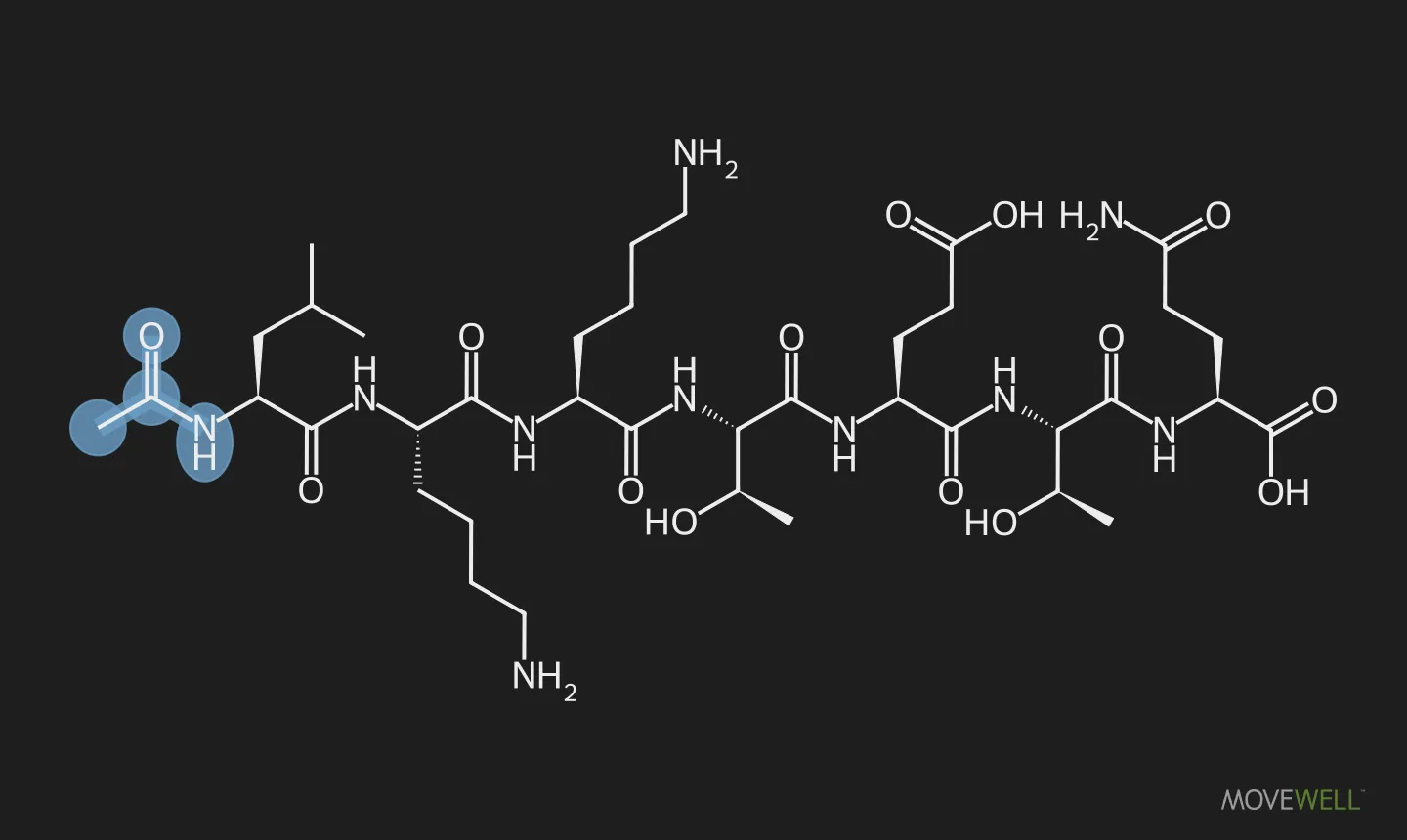
TB-500 is a synthetic 7-amino-acid peptide, not thymosin β4. FDA says plainly that "thymosin beta-4 and TB-500 are not the same substance." TB-500 is a short, acetylated piece of thymosin β4 (Tβ4), and FDA found no study in which it was given to people.1 The human trials often quoted for TB-500 used full-length Tβ4, and those efficacy trials mostly missed their main goals.15, 19, 20 In the one rat tendon study of TB-500, it did improve healing.5 Since October 28, 2026, HHS has said it won't act against licensed pharmacies that compound the acetate as an injection with a prescription. That is not FDA approval.6, 8
Often paired with BPC-157. See BPC-157 vs TB-500
In this guide
At a glance
| What it is | A synthetic 7-amino-acid fragment of thymosin β4 (residues 17–23) with an acetyl group on the first amino acid1 |
|---|---|
| Not the same as | Thymosin β4, the natural 43-amino-acid protein. FDA: "not the same substance"1 |
| Forms | Free base and acetate salt. The HHS policy covers only the acetate1, 3 |
| Best evidence | One 2026 rat Achilles tendon study, in which TB-500 alone improved strength and tissue scores5 |
| Human evidence | None. FDA found no article in which TB-500 was given to humans1 |
| Often confused with | Full-length Tβ4 trials in eye, skin and heart. Most missed their primary endpoints, and none tested TB-50015, 19, 20 |
| Legal status | Single-ingredient acetate, injected under the skin or into muscle, under HHS enforcement discretion. Not FDA-approved3, 6 |
| In sport | Banned at all times. WADA S2.3, growth factors: "Thymosin-β4 and its derivatives e.g. TB-500"4 |
| Main risks | Unknown in people. No toxicology studies exist. FDA flags immune reactions and poor characterization1, 2 |
| Typical cost | $149 a month for a compounded injection (pre-order)12 |
Where to get it
MoveWell sells no peptides. All options and prices
TB-500 injection pre-order at $149 a month. Needs a clinician review and prescription. Shipping targeted for late November. The page doesn't state the salt form.12
See SuperpowerMolecular structure
A straight chain of 7 amino acids with an acetyl cap on the first one. The cap is what separates TB-500 from plain LKKTETQ.
The N-terminal acetyl group
- Sequence
- Ac-LKKTETQ-OH
- Position
- Residues 17–23 of thymosin β4
- Length
- 7 amino acids + acetyl
- Formula
- C38H68N10O14
- Weight
- 889.01 g/mol
- Acetate
- C38H68N10O14 · CH3COOH, 949.1 g/mol
- CAS
- 885340-08-9 (free base). None for the acetate
- FDA UNII
- QHK6Z47GTG (free base). None for the acetate
Drawn from the sequence FDA lists. Formula and weight are for the free base as given by FDA; the acetate figures are from FDA and HHS.1, 3
What it is
FDA defines TB-500 as "a seven amino acid synthetic fragment of thymosin β4 and an acetyl group at the N-terminal amino acid." It appears to have first been made in 2003. "TB-500" is a common name, not an official drug name.1 Research funded by WADA identified the active content of products sold as TB-500 as "the N-terminal acetylated 17-23 fragment of thymosin beta4 (Ac-LKKTETQ)."14
Three molecules that get mixed up
| Molecule | What it is | Relevance |
|---|---|---|
| Thymosin β4 (Tβ4) | A natural 43-amino-acid protein. It binds actin, a building block of the cell skeleton1, 13 | Used in every human trial. Not TB-500 |
| TB-500 | Synthetic Ac-LKKTETQ, residues 17–23 of Tβ41 | What is sold and what HHS covers (acetate only). No human data |
| Ac-SDKP | A different 4-amino-acid piece, residues 1–4 of Tβ4, broken down by ACE26 | Not TB-500 and not part of the HHS policy |
FDA notes that "several websites state that TB-500 is a synthetic version of thymosin beta-4 and often use the terms interchangeably." They are different substances.1 FDA also found identity problems in what was submitted to it: the nomination listed a CAS number and formula that "matches neither TB-500 free base nor TB-500 acetate," and the papers reviewed don't clearly say which form they studied.1, 2
How it works
No one knows how TB-500 itself acts in the body. The theory comes from its parent protein.
- Actin binding. Thymosin β4 holds single actin units and helps regulate cell shape and movement.1, 13 FDA describes a 6-amino-acid segment, LKKTET, as Tβ4's actin-binding region. TB-500 contains that segment.1
- Cell migration and blood vessels. In rats, full-length Tβ4 sped wound closure and increased new blood vessel growth.22 In mice with a blocked heart artery, it improved heart-cell survival and heart function.23 These are Tβ4 results, not TB-500 results.
Two FDA-reviewed findings cut against simple extrapolation. A 2024 lab study found the TB-500 free base "appeared to be devoid of wound-healing properties" in a cell scratch test. A 2003 mouse study that did show benefit used the non-acetylated fragment, which FDA says "cannot be directly extrapolated to the N-acetylated heptapeptide TB-500."1
Evidence map
Each claimed use is graded for TB-500 itself. Trials of full-length thymosin β4 don't count toward these grades.
One rat Achilles study (n=32): TB-500 alone improved strength and tissue scores. Not yet repeated
FDA found no published animal wound study of TB-500 itself. One lab test of the free base showed no effect
No study of TB-500 found. Marketing and user reports only
Human trials exist only for full-length Tβ4, a different molecule. None tested TB-500
Scale: 5 FDA-approved, 4 strong human, 3 limited human, 2 animal or lab only, 1 anecdotal
Studies of TB-500 itself
| Use | Study | Model | Finding |
|---|---|---|---|
| Tendon | Biçer 20265 | Rat n=32, 4 groups of 8 | TB-500 alone: higher load to failure (p<0.05) and better Bonar and Movin tissue scores. BPC-157 alone: no statistically significant improvement. The combination improved only the Movin score and "did not confer additional benefits compared to either agent alone." The authors call it exploratory |
| Wounds | Rahaman 20241 | Lab cells | TB-500 free base gave no significant wound closure in a fibroblast scratch test |
| Wounds | Philp 20031 | Mouse aged | Positive, but used non-acetylated LKKTETQ on the skin. FDA: can't be directly extrapolated to TB-500. No dose-response |
| Absorption | Ho 20121 | Horse | Blood levels after an injection under the skin. Measurement only, no effect studied |
| Toxicology | FDA review1, 2 | None | No acute, repeat-dose, genetic, reproductive or cancer studies submitted or found |
FDA's summary: the nominator "did not submit, and FDA did not identify," published nonclinical in-vivo studies of TB-500's effects on wounds.2
The thymosin β4 trials (not TB-500)
Sellers often cite human trials as TB-500 evidence. Every one of them used full-length thymosin β4: RegeneRx's eye drops (RGN-259), skin gel (RGN-137) or IV form (RGN-352), or a Chinese recombinant Tβ4 (NL005).15, 16, 20, 21, 40, 41, 42 None tested TB-500, which is a different molecule given a different way; FDA found no study in which TB-500 was given to humans.1
| Trial | Design | Product | Result |
|---|---|---|---|
| ARISE-1, dry eye | Phase 2/3 n=317 | Tβ4 eye drops | Primary outcomes not met. Some secondary signals. No drug-related serious side effects16 |
| ARISE-2, dry eye | Phase 3 n=601 | Tβ4 eye drops | The sponsor said ARISE-2 "was not successful in duplicating the results of ARISE-1"44. Some signals at day 15 and in a subgroup. FDA then asked for a third trial17, 18 |
| ARISE-3, dry eye | Phase 3 n=700 | Tβ4 eye drops | "Did not meet its primary outcome measures." No serious side effects19, 43 |
| SEER-1, eye ulcers (neurotrophic keratopathy) | Phase 3 n=18, closed early | Tβ4 eye drops | Healed at 4 weeks: 6 of 10 vs 1 of 8 on placebo. Not significant on the primary test (p=0.0656)15 |
| Venous leg ulcers | Phase 2 n=72 | Tβ4 skin gel | Complete healing 33% on the middle dose vs 24% on placebo; "not deemed to be statistically significant"20 |
| Pressure ulcers | Phase 2 n=72 planned | Tβ4 on the skin | Listed as completed. No results found42 |
| IV safety | Phase 1 40 healthy volunteers | Tβ4 by IV | Side effects infrequent and mild or moderate. No serious events21 |
| Heart attack | Phase 2 n=62 and n=90 | Recombinant Tβ4 by IV | Both completed. No results posted or published that we found40, 41 |
Taken together, safety in the Tβ4 trials looked clean, but every efficacy trial with a reported primary result missed it. Tβ4 has no regulatory approval for any use in the sources we reviewed. None of this transfers to TB-500.1
By goal
Pick your goal to see what the evidence supports.
How it's used
TB-500 is sold as an injection. The HHS policy covers it only under the skin or into muscle; nasal, oral and topical TB-500 are outside it.3, 9
No human study has tested any dose, and there is no human data on how the body absorbs or clears it by any route.1, 2 The 2026 rat study gave a daily injection into the belly for 4 weeks.5 Per-kilogram human doses seen online have no study behind them. We don't give a dose.
Side effects and who should avoid it
- No human safety data. FDA is "concerned about the lack of human data on drug products containing TB-500," and says the potential risks to people are unknown.2
- No toxicology. No acute, repeat-dose, genetic, reproductive or cancer studies were submitted or found.1
- Immune reactions. FDA says injectable peptides "may pose a significant risk for immunogenicity, potentially amplified by aggregation." No such data were provided for TB-500.2
- Quality. The acetate certificate FDA reviewed capped total impurities at 2% but didn't identify them. The free-base certificate lacked assay, impurity, endotoxin and aggregate testing.1
- Cancer. There is no evidence TB-500 causes cancer, and no study has tested whether it does. FDA's written review raised no cancer finding; its concern was the missing studies.1 At the July 2026 advisory meeting, FDA and several panelists reportedly focused on a potential cancer signal.10 The worry rests on the parent protein: Tβ4 is often highly expressed in some cancers, and another Tβ4 fragment, Ac-SDKP, is raised in tumor tissue. Both findings are correlational and neither is about TB-500.24, 25 HHS called the safety concerns "inferential or mechanistic rather than observed," as reported by AJMC.9
- Reported side effects. FDA's adverse event database had no TB-500 reports through March 26, 2025; FDA says that "does not imply that the substance is safe." Its food complaint system had 2 cases of "blended TB-500 and BPC-157."1, 2 One of three FAERS reports on BPC-157 involved a BPC-157 + TB-500 "research purposes only" product.36
- Athletes. Prohibited at all times under WADA S2.3. The HHS policy doesn't change that.4
- Pregnancy, breastfeeding, active cancer. No human data and no reproductive studies.1 Ask a clinician.
Compared with
| BPC-157 | TB-500 | |
|---|---|---|
| What it is | 15-amino-acid fragment of a gastric juice protein | 7-amino-acid acetylated fragment of thymosin β4 |
| Human studies of the molecule | 5 small studies, no clear benefit | None |
| Rat Achilles study, 2026 | Not significant | Significant |
| HHS routes | Under the skin, muscle, oral, topical | Under the skin, muscle |
| WADA | S0 | S2.3 |
Sources: Biçer 2026,5 FDA briefings,1, 36 HHS Appendix B,3 WADA 2026 list.4 Full comparison: BPC-157 vs TB-500
Stacks
TB-500 is sold mostly in blends. Only one has been tested, in rats, and it added nothing. All blends fall outside the HHS policy.
Wolverine
Rats onlyNo human data. In a 2026 rat Achilles study the combination gave no added benefit over either alone. TB-500 alone produced the strongest result.5 The HHS policy allows one active ingredient, so the blend is excluded.3, 34
Myths vs evidence
All options and prices
MoveWell sells no peptides. Options inside the HHS policy first. Prices checked November 1, 2026
Licensed compounding, with a prescription
| Provider | Form | Price | Status |
|---|---|---|---|
| Superpower | TB-500 injection (salt form not stated) | $149 a month | Pre-order. Clinician review and prescription, US-licensed pharmacy, full refund if not approved. Ships late November. States it is not FDA-approved12 |
| Hims & Hers | Not announced | Not listed | Named TB-500 as a planned peptide. No launch confirmed32, 33 |
As of May 2026, FDA found no pharmacies compounding TB-500.1
Blends and research vials, outside the policy
Some storefronts sell TB-500 in Wolverine, GLOW or KLOW blends. The HHS policy covers single-ingredient products only, so we don't list them.3, 34 The policy also excludes research chemicals.7 In August 2026 FDA warned five peptide sellers that a "research use only" label doesn't excuse products clearly meant for people.35
Legal status history
Newest first.
- Current statusHHS says it won't take action against licensed 503A pharmacies, federal facilities and licensed physicians that compound single-ingredient TB-500 acetate, under the skin or into muscle, with a prescription. The policy is interim and open for comment, and state rules still apply. Not FDA-approved. Banned in sport.3, 7, 4
- A formal rule to add TB-500 to the 503A bulks list; none proposed yet. Comments on the HHS policy are due 2 weeks after Federal Register publication, about Nov 13, 2026 if it ran Oct 30 as scheduled (our calculation).6, 8
- HHS enforcement discretion policy for TB-500 acetate and five other peptides. Docket HHS-OASH-2026-0496. Not FDA approval; HHS may revisit it if safety or quality signals arise.6, 8
- The interim access policy is sent to the White House budget office for review.39
- FDA's compounding advisory committee votes 8–6–1 to recommend adding both the free base and the acetate, for wound healing. FDA staff recommended against. The vote is advisory, and the count comes from law-firm reports.10, 11
- FDA's review memo recommends not adding TB-500 to the bulks list, citing poor characterization, no history of compounding use, no evidence of effectiveness and no human safety data.1
- Removed from Category 2 (announced Apr 15) with 11 other peptides after nominations were withdrawn. This did not move it to Category 1. A Federal Register notice of Apr 16 put TB-500 on the July meeting agenda.3, 38, 27
- Placed in FDA's Category 2, substances that may pose significant safety risks in compounding.3
- US horse racing's medication consortium says TB-500 should be a Class A prohibited drug. WADA funds research to detect it.28, 14
What the HHS policy covers
| Form | TB-500 acetate only. Not the free base, even though the advisory committee voted for both |
|---|---|
| Routes | Under the skin or into muscle only. No nasal, oral or topical TB-500 |
| Who | State-licensed 503A pharmacies, federal facilities and licensed physicians, with a patient-specific prescription |
| Conditions | One active ingredient. Ingredient from an FDA-registered, CGMP-compliant maker named on the certificate. Full testing, including endotoxin for injectables. Only an FDA-cleared syringe in the pack. Serious side effects reported to FDA and the state. The label "This is a compounded drug product. Not for resale." |
| Excluded | Blends (for example BPC-157 with TB-500), 503B outsourcing facilities, research chemicals and supplements. The free base isn't covered |
| Standing | Not FDA approval. Lasts until a final rule. HHS may revisit it if safety or quality problems arise |
Sources: HHS Appendix B,3 BakerHostetler,7 FDA Law Blog,8 AJMC,9 Frier Levitt.34
In sport
WADA's 2026 Prohibited List names "Thymosin-β4 and its derivatives e.g. TB-500" under S2.3, growth factors, prohibited at all times. That is a different class from BPC-157, which sits under S0.4 Sport Integrity Australia lists TB-500 as another name for thymosin β4, "banned in sport at all times."30 WADA's 2027 list takes effect January 1, 2027. A summary of it lists no change to S2; we have not read the full list.31 In 2016, the Court of Arbitration for Sport banned 34 past and present Essendon AFL players for using thymosin β4.29
FAQ
Is TB-500 the same as thymosin beta-4?
No. FDA says they are not the same substance. TB-500 is a 7-amino-acid acetylated piece (Ac-LKKTETQ) of the 43-amino-acid protein.
Has TB-500 been tested in people?
No. FDA found no study in which TB-500 was given to humans. The human trials people cite used full-length thymosin β4, and most missed their primary goals.
Is TB-500 legal?
HHS says it won't act against licensed pharmacies that compound single-ingredient TB-500 acetate, injected under the skin or into muscle, with a prescription. That is enforcement discretion, not FDA approval. Blends, the free base and research vials are outside it.
Does it work for tendon injuries?
It hasn't been tested in people. One rat Achilles study found TB-500 alone improved tendon strength and tissue scores. That's a promising animal signal, not proof.
Is it better with BPC-157?
The only test, in rats, found the combination added nothing over either alone. A pre-mixed vial is outside the HHS policy.
What dose do people use?
No human study has tested a dose. We don't give one.
Can athletes use it?
No. WADA lists TB-500 under S2.3 and bans it in and out of competition.
Does it cause cancer?
No one knows. No cancer study exists. The concern comes from the parent protein's role in cell growth and blood vessels, not from any TB-500 finding.
References
44 sources, with links
- FDA. Review memo: TB-500-related bulk drug substances (May 15, 2026). Pharmacy Compounding Advisory Committee, Jul 23–24, 2026. fda.gov
- FDA. July 23, 2026 FDA presentations (PCAC), TB-500 section. fda.gov
- HHS. 503A peptide enforcement discretion policy, Appendix B. hhs.gov
- World Anti-Doping Agency. 2026 Prohibited List, S0 and S2.3 (copy hosted by SEGAS). PDF
- Biçer O et al. Effects of BPC-157 and TB-500 on Achilles tendon healing in rats. Joint Dis Relat Surg 2026;37(3):822–837. DOI 10.52312/jdrs.2026.2951
- Federal Register public inspection. FR Doc. 2026-22192, HHS notice of availability, docket HHS-OASH-2026-0496, RIN 0910-ZD94. Link
- BakerHostetler. HHS issues enforcement discretion policy regarding 503A compounding using certain peptide bulk drug substances (Oct 28, 2026). Link
- Hyman Phelps, FDA Law Blog. The PEPTIDE-L wave reaches HHS (Oct 28, 2026). Link
- AJMC. HHS draft policy eases enforcement on 6 compounded peptides (Oct 29, 2026). Link
- Hyman Phelps, FDA Law Blog. Peptide-l wave: PCAC approves four bulk drug substances for the 503A list (Jul 2026). Link
- McDermott Will & Schulte. Bulk-list bound: PCAC backs majority of peptides in two-day public meeting. Link
- Superpower. Peptides pricing page (checked Nov 1, 2026). Link
- T3DB. Thymosin beta-4 (UniProt P62328). Link
- WADA. Investigation of in vitro/ex vivo TB-500 metabolism (Van Eenoo, 2013). Link
- Sosne G et al. 0.1% RGN-259 (thymosin β4) ophthalmic solution in neurotrophic keratopathy: a phase III trial. Int J Mol Sci 2023;24(1):554. Link
- RegeneRx/ReGenTree. RGN-259 confirms efficacy in signs and symptoms of dry eye (sponsor release, May 6, 2016). Link
- BioCentury. ReGenTree reports Phase III data for RGN-259 in dry eye syndrome (Feb 16, 2018). Link
- RegeneRx. Outcome of FDA discussions for development of RGN-259 for dry eye syndrome (Apr 9, 2018). Link
- American Pharmaceutical Review. ARISE-3 dry eye trial does not meet primary outcome measures (2021). Link
- FierceBiotech. RegeneRx reports Phase II venous stasis trial results (Mar 26, 2009). Link
- Ruff D et al. A randomized, placebo-controlled, single and multiple dose study of intravenous thymosin β4 in healthy volunteers. Ann N Y Acad Sci 2010;1194:223–9. PubMed
- Malinda KM et al. Thymosin β4 accelerates wound healing. J Invest Dermatol 1999;113(3):364–8. PMID 10469335
- Bock-Marquette I et al. Thymosin β4 activates integrin-linked kinase and promotes cardiac cell migration, survival and cardiac repair. Nature 2004;432:466–472. Link
- Yoon SY et al. Thymosin β4 expression correlates with lymph node metastasis through HIF-α induction in breast cancer. Oncol Rep 2011;25(1):23–31. Link
- Overexpression of the natural tetrapeptide Ac-SDKP derived from thymosin β4 in neoplastic diseases. Ann N Y Acad Sci 2010;1194:53–59. PubMed
- Cavasin MA et al. Prolyl oligopeptidase is involved in release of the antifibrotic peptide Ac-SDKP. Hypertension 2004;43:1140. PMID 15037553
- Federal Register 91 FR 20465 (Apr 16, 2026), FR Doc. 2026-07361, docket FDA-2025-N-6895. govinfo.gov
- Daily Racing Form. RMTC adds two drugs to banned medication list (Jul 2, 2013). Link
- AFL.com.au. Guilty: court bans the Essendon 34 for 2016 (Jan 12, 2016). Link
- Sport Integrity Australia. Thymosin beta-4. Link
- World Rugby. WADA publishes 2027 Prohibited List (Oct 6, 2026). Link
- Glossy. Hims & Hers plots rapid expansion into peptide therapies (Aug 19, 2026). Link
- Stocktwits. HIMS stock jumps after HHS temporarily clears compounding of six peptides (Oct 28, 2026). Link
- Frier Levitt. HHS peptide enforcement discretion (Oct 28, 2026). States the policy "would not extend to a compounded product combining BPC-157 and TB-500." Link
- ArentFox Schiff. RUO-ined: five peptide vendors learn research use only is not a legal strategy (Aug 2026). Link
- FDA. Briefing document: BPC-157-related bulk drug substances. Pharmacy Compounding Advisory Committee, Jul 23–24, 2026. fda.gov
- Superpower. GLOW peptide guide. Link
- Orrick. FDA announces removal of 12 peptides from Category 2 and schedules PCAC meetings (Apr 16, 2026). Link
- Holland & Knight. Peptides at a crossroads: what wellness providers need to know (Oct 16, 2026). Link
- NL005 acute myocardial infarction Phase 2a, NCT05485818 (registry mirror). Link
- NL005 acute myocardial infarction Phase 2b, NCT05984134 (registry mirror). Link
- Thymosin β4 in pressure ulcers, NCT00382174 (registry mirror). Link
- ARISE-3 (RGN-259 for dry eye), NCT03937882 (registry mirror). Link
- RegeneRx. RegeneRx JV announces results of ARISE-2 dry eye trial (sponsor release, Oct 31, 2017). Link
This page is for education and is not medical advice. TB-500 is not FDA-approved. Talk to a clinician before using any peptide, especially by injection.