KPV
Also called Lys-Pro-Val, α-MSH (11–13), KPV acetate1, 9
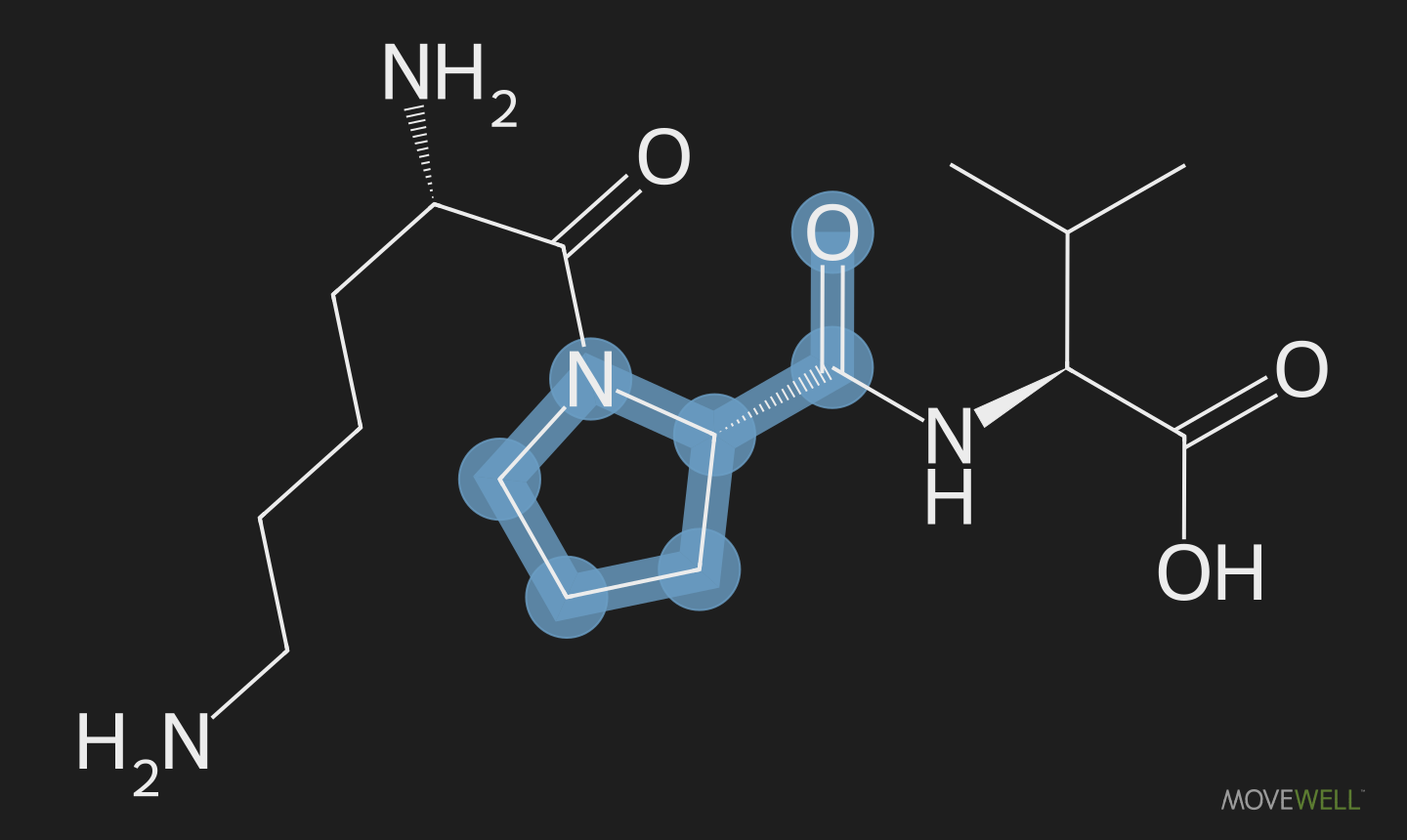
KPV is a chain of 3 amino acids: lysine, proline and valine. It is the last 3 amino acids of α-MSH, a hormone that also calms inflammation.9 In mice it eased chemically induced colitis, and in rodents it helped wounds heal.1, 11, 12 FDA found no study that gave KPV to a person.1 Since October 28, 2026, HHS has said it won't act against licensed pharmacies that compound it as a cream or a pill, with a prescription. Injections aren't covered.6
Often sold alongside BPC-157 for gut health. See every peptide's status in the regulatory tracker
In this guide
At a glance
| What it is | A synthetic 3-amino-acid peptide, Lys-Pro-Val. It matches the end of α-MSH (residues 11 to 13)1, 9 |
|---|---|
| Forms | Free base and acetate salt. The HHS policy covers only the acetate1, 6 |
| Best evidence | Mouse colitis studies and rodent wound-healing studies1, 11, 12 |
| Human evidence | None. FDA found no published human study and no registered trial1 |
| No human evidence for | Gut inflammation, skin conditions, wound healing, any route |
| Legal status | Acetate can be compounded as a cream or by mouth, with a prescription, under HHS enforcement discretion. Not FDA-approved6, 7 |
| In sport | Not named on WADA's 2026 list, but likely covered by S0, which bans unapproved substances at all times16 |
| Main risks | Unknown in people. No animal toxicity studies exist. FDA cites possible immune reactions and poor characterization1 |
| Typical cost | No confirmed listing for an in-policy product |
Where to get it
MoveWell sells no peptides. Some links may earn us a commission, which never decides what's listed or the order. All options
HHS covers single-ingredient KPV acetate as a cream or by mouth. As of Nov 1 we found no provider page for either form that we could confirm.6
DetailsMolecular structure
Three amino acids in a short chain: lysine, then proline, whose side chain closes into a ring, then valine.
The proline (Pro), the middle residue
- Sequence
- KPV (H-Lys-Pro-Val-OH)
- Length
- 3 amino acids
- Formula
- C16H30N4O4
- Weight
- 342.4 g/mol
- Acetate
- C16H30N4O4 · CH3COOH, 402.5 g/mol
- CAS
- 67727-97-3
- FDA UNII
- Not assigned
Drawn from the sequence FDA lists. Formula and weight are for the free base; acetate values are from FDA and HHS.1, 6
What it is
α-MSH is a 13-amino-acid hormone best known for skin pigment. It also dampens inflammation. Researchers found that its last three amino acids, "alpha-MSH 11-13, KPV," keep much of that anti-inflammatory effect.9 A 2008 review proposed KPV as an alternative to α-MSH because it shouldn't darken the skin.10
What's sold is synthetic. FDA found the nominator's paperwork named KPV acetate but gave the free-base formula, so it was unclear which form had been nominated. FDA called both forms not well-characterized.1 FDA found no KPV product authorized in the EU, and KPV is not in the US, European or Japanese pharmacopeias.1
How it works
The proposed mechanisms come from cell and animal work.
- Calming inflammatory signals. In gut and immune cells, tiny (nanomolar) amounts of KPV blocked NF-κB and MAP kinase, two switches that turn on inflammation.11
- Getting into gut cells. KPV is carried into cells by PepT1, a transporter that increases in the inflamed colon.11
- Not mainly through α-MSH's receptor. KPV still protected mice lacking a working melanocortin-1 receptor, so its effect is "at least partially independent" of it.12 FDA says melanocortin receptors are unlikely to be its main targets.1
None of this has been measured in people.
Evidence map
Each claimed use is graded separately, because the evidence differs by use.
Mouse colitis models and gut cell lines. No human study
Rodent wound and eye-surface models, as summarized by FDA
A mouse contact-allergy model only. No study in people with either condition, and KPV barely passes through skin in the lab
Worked in drinking water in mice. Human absorption has never been measured
Scale: 5 FDA-approved, 4 strong human, 3 limited human, 2 animal or lab only, 1 anecdotal
Key studies
| Use | Study | Model | Finding |
|---|---|---|---|
| Colitis | Dalmasso 200811 | Mouse and cells DSS and TNBS colitis | KPV by mouth, in drinking water, reduced colitis in both models and lowered inflammatory signals |
| Colitis | Kannengiesser 200812 | Mouse DSS and T-cell transfer colitis | Faster weight regain and less inflammation. Protected all treated mice lacking the MC1 receptor from death |
| Colitis | Mol Ther 201713 | Mouse oral nanoparticles | KPV packed in nanoparticles inside a gel sped gut-lining healing and lowered TNF-α |
| Wounds | Getting 2003; Bonfiglio 2006; Zhao 20221 | Rodent | Effective in rodent wound-healing models, including the eye surface |
| Skin allergy | Luger 20039 | Mouse contact hypersensitivity | KPV on the skin or given systemically blocked an allergic skin reaction, as summarized in a review |
| Skin uptake | Pawar 20171 | Lab human cadaver skin | "KPV does not permeate well through skin." Electric current or microneedles increased uptake |
| Any use | FDA search1 | Humans none found | No published human study and no ClinicalTrials.gov entry |
| Colitis | Kucharzik 201714 | Human RCT K(D)PT, not KPV | A related tripeptide by mouth. Pooled doses beat placebo at weeks 2 and 4, against a "very high placebo rate." Well tolerated |
The only human trial nearby tested K(D)PT (Lys-D-Pro-Thr), a different molecule modeled on a piece of IL-1β.10, 14 Its results don't transfer to KPV. The skin and wound studies are cited as FDA summarized them.1
By goal and route
Pick your goal to see what the evidence supports.
| Topical | Oral | Injection | |
|---|---|---|---|
| HHS policy | Covered, acetate only | Covered, acetate only, with documented human bioavailability | Not covered |
| Human evidence | None | None | None |
| Animal or lab evidence | Rodent wounds. Poor uptake through cadaver skin | Mouse colitis, in drinking water | No study of the injections people buy |
| Known risks | Unknown | Unknown | Unknown. FDA can't rule out immune reactions by any route |
Sources: HHS policy terms,6, 7 FDA briefing,1 Dalmasso 2008.11
How it's used
No human study has set a dose for any route. We don't give one.
The nominator proposed a cream or gel for the skin.1 Oral products appear on promotional websites, but FDA found no study of how well KPV is absorbed by mouth in people.1 The HHS policy asks pharmacies to document human oral absorption before compounding an oral form.6 In mice, KPV worked in drinking water at very low (nanomolar) concentrations.11 We report this as information, not instruction.
Side effects and who should avoid it
- No safety studies. FDA found no single-dose, repeat-dose, genetic, reproductive or cancer toxicity studies.1
- Immune reactions. FDA says there is "insufficient data to conclude" KPV doesn't carry the immune and clumping risks of other peptides.1
- Reported side effects. None in FDA's adverse event database through December 3, 2025. FDA notes compounders rarely report.1
- The core problem. FDA is "particularly concerned about the lack of any human data."1
- Gray-market vials. "Research use only" products aren't covered by the HHS policy or its testing conditions.6, 7
- Athletes. KPV isn't named on WADA's list, but S0 bans, at all times, any substance not covered elsewhere on the list that has no government approval for human use. We found no approval for KPV, so it is likely prohibited.1, 16 Ask your anti-doping body first.
- Pregnancy and breastfeeding. No data.
Approved treatments exist for colitis, psoriasis, eczema and wounds, which FDA cited in its recommendation.1 See a clinician first.
Compared with
| KPV | K(D)PT | BPC-157 | |
|---|---|---|---|
| What it is | Last 3 amino acids of α-MSH | KPV-like tripeptide modeled on IL-1β | 15-amino-acid fragment of a gastric protein |
| Human gut evidence | None | One phase 2a colitis trial | One enema trial, no better than placebo |
| PCAC vote, Jul 2026 | 8–6–1 | Not reviewed | 8–6–1 |
| HHS routes | Topical, oral | Not covered | Under the skin, muscle, oral, topical |
Sources: FDA KPV briefing,1 Kucharzik 2017,14 McDermott,3 HHS Appendix B.6 BPC-157 details are on its guide
Stacks
No study has tested KPV with any other peptide. All blends fall outside the HHS policy, which allows one active ingredient.6
KLOW
Marketing onlyThe GLOW blend plus KPV, usually sold as one injectable vial. "No human trial has tested either blend," and none tested KPV with the others.15 Excluded as a blend, and injected KPV is outside the policy anyway.6
BPC-157 + KPV
No dataSold for gut health, often as capsules. We found no study of the combination. Excluded as a blend.6
Myths vs evidence
All options
MoveWell sells no peptides. Some links may earn us a commission; that never decides what's listed or the order. Checked November 1, 2026
Licensed compounding, with a prescription
We found no provider page we could confirm for single-ingredient KPV acetate as a cream or by mouth. One telehealth site lists KPV as "coming soon" with no form or price. Another lists KPV injections, which fall outside the policy, so we don't link it. We'll add options when a compliant product is listed.
Compounded drugs are generally not covered by insurance, and the HHS policy requires a patient-specific prescription.6
Research use only vials
The HHS policy excludes research chemicals, so we don't list sellers.7 In August 2026 FDA warned five peptide sellers that a "research use only" label doesn't excuse products clearly meant for people.17
Legal status history
Newest first.
- Current statusHHS says it won't take action against licensed 503A pharmacies, federal facilities and licensed physicians that compound single-ingredient KPV acetate as a cream or by mouth, with a prescription. Not FDA-approved. Not named by WADA, but likely covered by S0.6, 7, 16
- A formal rule to add KPV to the 503A bulks list. Comments on the HHS policy are due 2 weeks after Federal Register publication, which was scheduled for Oct 30, 2026.7, 19
- HHS enforcement discretion policy for KPV and five other peptides. Docket HHS-OASH-2026-0496. Not approval, and interim until a final rule.7, 19
- FDA's compounding advisory committee votes 8–6–1 in favor, for the free base and acetate. The uses reviewed were wound healing and inflammatory conditions. The vote is advisory.2, 3, 4, 5, 18
- FDA staff review recommends against listing: poorly characterized, unknown compounding use, no human data, and approved treatments exist.1
- Moved off Category 2 to FDA's "nominated but withdrawn" list. That did not make it legal to compound.8
- Placed in Category 2, substances that may pose significant safety risks.6, 8
What the HHS policy covers
| Form | KPV acetate only |
|---|---|
| Routes | Topical and oral dosage forms only. Not injection |
| Who | State-licensed 503A pharmacies, federal facilities and licensed physicians |
| Conditions | A patient-specific prescription. One active ingredient. Ingredient from an FDA-registered, CGMP-compliant maker with a full testing certificate. Documented human bioavailability for oral forms. Serious side effects reported to FDA and the state. The label "This is a compounded drug product. Not for resale." |
| Excluded | Injections, blends such as KLOW, 503B outsourcing facilities, research chemicals and supplements |
| Standing | Not FDA approval. HHS may revise or withdraw it if safety or quality problems arise |
Sources: HHS Appendix B,6 BakerHostetler.7 Official meeting minutes weren't posted when we checked; the vote count comes from law-firm and trade reports, which agree. See every peptide's status in the regulatory tracker.
FAQ
Is KPV legal?
Single-ingredient KPV acetate can be compounded by a licensed pharmacy as a cream or by mouth, with a prescription, under an HHS policy from October 28, 2026. That is not FDA approval. Injections, blends and research vials are outside the policy.
Is it FDA-approved?
No. FDA staff recommended against adding it to the compounding list, and FDA found no authorized KPV product in the EU either.
Has KPV been tested in people?
No. FDA found no published human study and no registered trial.
What does it have to do with α-MSH?
KPV is α-MSH's last three amino acids (positions 11 to 13). It keeps some of the hormone's anti-inflammatory activity in lab studies.
Does it help colitis or IBD?
It reduced colitis in mice. It hasn't been tested in people with colitis. Approved treatments exist; see a gastroenterologist.
Does a KPV cream work?
No one knows. In a lab test on human skin, KPV barely got through.
What dose do people use?
No human study has set a dose. We don't give one.
What is KLOW?
A blend of GHK-Cu, BPC-157, TB-500 and KPV. No study has tested it, and blends fall outside the HHS policy.
Can athletes use it?
Probably not. KPV isn't named on WADA's 2026 list, but the S0 category bans unapproved substances at all times, and KPV isn't approved in the US or EU. Check with your anti-doping body.
References
19 sources, with links
- FDA. Briefing document: KPV-related bulk drug substances (review dated May 12, 2026). Pharmacy Compounding Advisory Committee, Jul 23–24, 2026. fda.gov
- FDA. July 23–24, 2026 meeting of the Pharmacy Compounding Advisory Committee. fda.gov
- McDermott Will & Schulte. Bulk-list bound: PCAC backs majority of peptides in two-day public meeting (Jul 27, 2026). Link
- AmSpa. FDA advisory committee recommends adding six of seven peptides to compounding list (Jul 24, 2026). Link
- Hyman Phelps, FDA Law Blog. Peptide-l wave: PCAC approves four bulk drug substances for the 503A list (Jul 24, 2026). Link
- HHS. 503A peptide enforcement discretion policy, Appendix B. hhs.gov
- BakerHostetler. HHS issues enforcement discretion policy regarding 503A compounding using certain peptide bulk drug substances (Oct 28, 2026). Link
- FDA. Certain bulk drug substances for use in compounding that may present significant safety risks (current as of Apr 22, 2026). fda.gov
- Luger TA, Scholzen TE, Brzoska T, Böhm M. New insights into the functions of alpha-MSH and related peptides in the immune system. Ann N Y Acad Sci 2003;994:133–140. PubMed
- Brzoska T et al. Alpha-melanocyte-stimulating hormone and related tripeptides: biochemistry, antiinflammatory and protective effects in vitro and in vivo. Endocr Rev 2008;29(5):581–602. PubMed
- Dalmasso G et al. PepT1-mediated tripeptide KPV uptake reduces intestinal inflammation. Gastroenterology 2008;135(1):166–178. PubMed
- Kannengiesser K et al. Melanocortin-derived tripeptide KPV has anti-inflammatory potential in murine models of inflammatory bowel disease. Inflamm Bowel Dis 2008;14(3):324–331. DOI 10.1002/ibd.20334
- Orally targeted delivery of tripeptide KPV via hyaluronic acid-functionalized nanoparticles efficiently alleviates ulcerative colitis. Mol Ther 2017. PMID 28143741. PubMed
- Kucharzik T et al. Tripeptide K(D)PT is well tolerated in mild-to-moderate ulcerative colitis: results from a randomized multicenter study. Inflamm Bowel Dis 2017;23(2):261–271. DOI 10.1097/MIB.0000000000001000
- Superpower. GLOW peptide guide (a telehealth seller's guide; used only for its statements that no trial has tested the blends and none tested KPV with the other peptides). Link
- World Anti-Doping Agency. 2026 Prohibited List; KPV is not named; S0 covers non-approved substances, prohibited at all times (copy hosted by SEGAS). PDF
- ArentFox Schiff. RUO-ined: five peptide vendors learn research use only is not a legal strategy (Aug 2026). Link
- DLA Piper. FDA AdComm recommends adding six peptides to bulk list (Jul 31, 2026). Link
- Federal Register public inspection. FR Doc. 2026-22192, HHS notice of availability, docket HHS-OASH-2026-0496. Link
This page is for education and is not medical advice. KPV is not FDA-approved. Talk to a clinician before using any peptide.