MOTS-c
Also called mitochondrial open reading frame of the 12S rRNA-c, MOTSc, MOTS-c acetate1, 15
We may earn a commission from links on this page. It never decides our picks. How we make money
MOTS-c is a chain of 16 amino acids encoded in mitochondrial DNA, not in the cell nucleus. In a 2015 mouse study it prevented diet-induced weight gain and insulin resistance.10 FDA found no human study of MOTS-c itself.1 A modified version, CB4211, was tested for 4 weeks in 20 people with fatty liver; liver fat fell about as much on placebo.12 Since October 28, 2026, HHS has said it won't act against licensed pharmacies that compound it as an injection with a prescription. WADA bans it at all times.7, 15
See every peptide's status in the regulatory tracker
In this guide
At a glance
| What it is | A synthetic 16-amino-acid peptide. The body makes it from a short gene inside the mitochondrial 12S rRNA1, 10 |
|---|---|
| Forms | Free base and acetate salt. The HHS policy covers only the acetate1, 7 |
| Best evidence | Mouse studies of diet-induced obesity, insulin resistance, exercise capacity and aging10, 11 |
| Human evidence | None for MOTS-c itself. One small 4-week trial of an analog, CB4211, reported in a company press release1, 12 |
| No human evidence for | Weight loss, blood sugar, endurance, bone or longevity |
| Legal status | Acetate can be compounded as an injection, with a prescription, under HHS enforcement discretion. Not FDA-approved7, 8 |
| In sport | Banned at all times (WADA S4.4.1, AMPK activators)15, 17 |
| Main risks | Unknown in people. FDA cites immune reactions and impurities. No animal toxicity studies1, 9 |
| Cost | One provider lists $199 a month for a compounded injection (pre-order). We found no other confirmed listing19 |
Where to get it
MoveWell sells no peptides. All options and prices
MOTS-c injection pre-order at $199 a month, including a blood panel. Needs a clinician review and prescription. Not available in all states. Shipping targeted for late November. The product page doesn't name the salt form; the policy covers only the acetate.19, 21
See SuperpowerMolecular structure
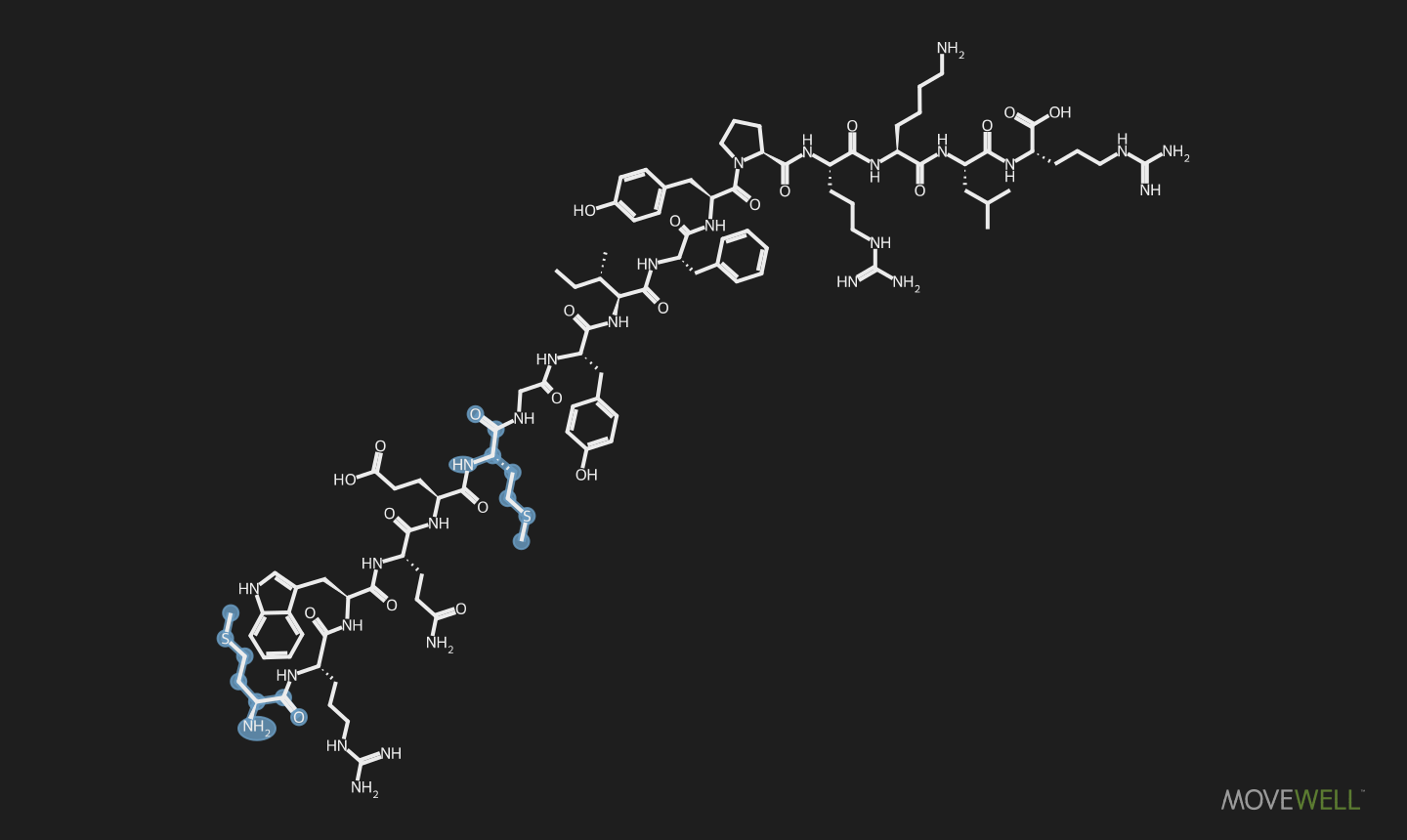
A straight chain of 16 amino acids with no ring between residues. Two methionines carry its only sulfur atoms.
The two methionines (Met 1 and Met 6)
- Sequence
- MRWQEMGYIFYPRKLR
- Length
- 16 amino acids
- Formula
- C101H152N28O22S2
- Weight
- 2174.6 g/mol
- Acetate
- C101H152N28O22S2 · CH3COOH, 2234.6 g/mol
- CAS
- 1627580-64-6
- FDA UNII
- A5CV6JFB78 (free base)
Drawn from the sequence FDA lists. Formula and weight are for the free base; acetate values are from FDA and HHS.1, 7
What it is
Most of the body's proteins are coded in the cell nucleus. MOTS-c is one of a few peptides coded in mitochondria, the cell's power plants. FDA describes it as "encoded by a short open reading frame (sORF) within the mitochondrial 12S rRNA."1 It was first described in mice in a 2015 paper.10
The body makes small amounts on its own. In 10 young men, levels in muscle rose about 12-fold after a hard cycling session, and blood levels rose about 1.5-fold before returning to normal within 4 hours.11 That is the body's own MOTS-c, not an injected dose. Commercial antibody (ELISA) blood tests may be unreliable: an anti-doping lab's mass-spectrometry method couldn't confirm the levels ELISA studies had reported.18
What's sold is synthetic. FDA called both the free base and the acetate not well-characterized, and the acetate certificate it reviewed lacked impurity and endotoxin testing.1
How it works
The proposed mechanism comes from mouse and cell work.10
- Muscle is the main target. The 2015 study found skeletal muscle was where it acted most.10
- Folate cycle and AMPK. It slows the folate cycle and purine building, which switches on AMPK, a sensor of the cell's energy state.10
- Why sport cares. WADA names it as an example of an AMPK activator, a banned class of metabolic modulators.15
FDA says it is unknown whether injected MOTS-c reaches active levels in people.1
Evidence map
Each claimed use is graded separately, because the evidence differs by use.
Mice on a high-fat diet gained less weight. In the CB4211 analog trial, only a "trend" in weight with no numbers
Mouse data. The analog trial reported a 6% glucose drop in 11 people over 4 weeks
Mice ran better on a treadmill. No human performance study
Old mice showed a lifespan trend that wasn't statistically significant overall
Rat cells and mouse skull models, as summarized by FDA
Scale: 5 FDA-approved, 4 strong human, 3 limited human, 2 animal or lab only, 1 anecdotal
Key studies
| Use | Study | Model | Finding |
|---|---|---|---|
| Fatty liver | CohBar 2021, CB421112, 13 | Human RCT analog, n=20 | 4 weeks of daily injections. ALT down 21% vs up 4% on placebo; glucose down 6%. Liver fat fell about equally in both groups. Press release only |
| Safety | CohBar 2021, CB421112 | Human analog, n=65 healthy | 1-week dose-ranging study. No serious side effects reported |
| Prediabetes | NCT0750574514 | Recruiting planned n≈120 | MOTS-c vs placebo by injection for 12 weeks. No results yet |
| Exercise | Reynolds 202111 | Human n=10, body's own MOTS-c | Muscle levels rose about 12-fold after cycling. Nothing was injected |
| Obesity | Lee 201510 | Mouse | Less weight gain and less insulin resistance on a high-fat diet, by injection into the belly |
| Exercise, aging | Reynolds 202111 | Mouse | Better treadmill running. Late-life treatment: median lifespan up 6.4%, not significant overall (P = 0.23) |
| Bone | Hu & Chen 2018; Yan 20191 | Rat cells, mouse | More bone-cell formation in a dish; less bone loss in a mouse skull model |
| Blood vessels | Wei 20201 | Rat | Less artery calcification |
FDA found no clinical study or human exposure data for MOTS-c.1 CB4211 is "a novel and improved analog of MOTS-c," not the same molecule, and we found its results only in a company press release.12 Bone and vessel studies are cited as FDA summarized them. Even a provider that sells it calls the evidence "preclinical and observational."22
By goal and route
Pick your goal to see what the evidence supports.
| Injection | Oral | Nasal or topical | |
|---|---|---|---|
| HHS policy | Covered, under the skin or into muscle, acetate only | Not covered | Not covered |
| Human evidence | None for MOTS-c. One 4-week analog trial | None | None |
| Known risks | FDA cites immune reactions and impurities | Unknown | Unknown |
| Cost | $199 a month (pre-order) | No legal source | No legal source |
Sources: HHS policy terms,7, 8 FDA briefing,1 CohBar,12 Superpower pricing.19
How it's used
No human study has set a dose for MOTS-c. We don't give one.
The nominator proposed injection under the skin.1 FDA found no study of how the body absorbs or clears it, and no half-life.1 In mice it was injected into the belly.1 The CB4211 analog was given as a daily injection under the skin for 4 weeks.12 We report these as information, not instruction.
Side effects and who should avoid it
- Immune reactions. FDA is "concerned about potential for immunogenicity when administered by an injection."1 A provider's consent form warns antibodies could interfere with the body's own MOTS-c.21
- Impurities. The acetate certificate FDA reviewed lacked impurity and endotoxin testing.1
- No safety studies. No single-dose, repeat-dose, genetic, reproductive or cancer toxicity studies exist.1
- Reported side effects. None in FDA's adverse event database.1 USADA cites reports of increased heart rate, palpitations, injection-site irritation, insomnia and fever.17 In the analog trial, injection-site reactions were the only common effect.12
- Blood sugar. Because it acts on glucose handling, low blood sugar is a listed risk, especially with diabetes drugs.21
- Athletes. Prohibited at all times under WADA S4.4.1. No therapeutic use exemption is possible, and a prescription doesn't change that.15, 17, 21
- Who is excluded. One provider excludes people under 18, anyone pregnant, breastfeeding or trying to conceive, and anyone with a history of cancer.21
FDA noted approved treatments exist for obesity and osteoporosis.1 See a clinician first.
Compared with
| MOTS-c | CB4211 | |
|---|---|---|
| What it is | The natural 16-amino-acid peptide | CohBar's modified analog of MOTS-c |
| Human testing | None completed. Phase 2a recruiting | Phase 1a/1b, 88 enrolled, completed 2021 |
| Published results | Mouse papers | Company press release only |
| Can you get it | Compounded injection, with a prescription | No. Not sold |
Sources: FDA briefing,1 CohBar,12 ClinicalTrials.gov,13, 14 HHS Appendix B.7
Stacks
We found no study of MOTS-c combined with any other peptide. Any blend falls outside the HHS policy, which allows one active ingredient per product.7, 8
Myths vs evidence
All options and prices
MoveWell sells no peptides. Options inside the HHS policy first. Prices checked November 1, 2026
Licensed compounding, with a prescription
| Provider | Form | Price | Status |
|---|---|---|---|
| Superpower | MOTS-c injection under the skin | $199 a month, includes a blood panel | Pre-order. Clinician review and prescription, US-licensed pharmacy, full refund if not approved. Not in all 50 states. Not HSA/FSA eligible. Ships late November19, 20 |
Superpower's product page doesn't name the salt form. Its consent form says the HHS policy applies only to MOTS-c acetate.21 Compounded drugs are generally not covered by insurance.
Research use only vials
The HHS policy excludes research chemicals, so we don't list sellers.8 In August 2026 FDA warned five peptide sellers that a "research use only" label doesn't excuse products clearly meant for people.24 USADA says MOTS-c can't legally be sold as a dietary supplement.17
Legal status history
Newest first.
- Current statusHHS says it won't take action against licensed 503A pharmacies, federal facilities and licensed physicians that compound single-ingredient MOTS-c acetate for injection under the skin or into muscle, with a prescription. Not FDA-approved. Banned in sport.7, 8, 15
- A formal rule to add MOTS-c to the 503A bulks list. A phase 2a trial is due to finish around Feb 2027.8, 14
- HHS enforcement discretion policy for MOTS-c and five other peptides. Not approval, and interim until a final rule.8
- WADA publishes its 2027 list, in force Jan 1, 2027. No change reported to the AMPK class that names MOTS-c.23
- FDA's compounding advisory committee votes in favor, for the free base and acetate, reported as 7–5–2 (one firm reports 8–6–1). The uses reviewed were obesity and osteoporosis. The vote is advisory.2, 3, 4, 5
- FDA staff review recommends against listing: poorly characterized, unknown compounding use, no human data, and approved treatments exist.1
- Moved off Category 2 to FDA's "nominated but withdrawn" list. That did not make it legal to compound.9
- Named on WADA's Prohibited List as an example of an AMPK activator.16
- Placed in Category 2, citing immune risk by injection and impurity concerns.7, 9
- CohBar completes its CB4211 analog trial.12, 13
The July vote is reported as 7–5–2 by three sources;3, 4, 5 one firm reports 8–6–1.6 FDA minutes weren't posted when we checked on November 1, 2026.
What the HHS policy covers
| Form | MOTS-c acetate only |
|---|---|
| Routes | Injection under the skin or into muscle only |
| Who | State-licensed 503A pharmacies, federal facilities and licensed physicians |
| Conditions | A patient-specific prescription. One active ingredient. Ingredient from an FDA-registered, CGMP-compliant maker with a full testing certificate, including endotoxin. Only an FDA-cleared syringe in the pack. Serious side effects reported to FDA and the state. The label "This is a compounded drug product. Not for resale." |
| Excluded | Oral, nasal and topical forms, blends, 503B outsourcing facilities, research chemicals and supplements |
| Standing | Not FDA approval. HHS may revise or withdraw it if safety or quality problems arise |
Sources: HHS Appendix B,7 BakerHostetler.8 See every peptide's status in the regulatory tracker.
FAQ
Is MOTS-c legal?
Single-ingredient MOTS-c acetate can be compounded by a licensed pharmacy as an injection, with a prescription, under an HHS policy from October 28, 2026. That is not FDA approval. Oral and nasal forms, blends and research vials are outside the policy.
Is it FDA-approved?
No. FDA staff recommended against adding it to the compounding list.
Has it been tested in people?
Not MOTS-c itself, as of Nov 2026. A modified version, CB4211, was tested for 4 weeks in a small trial. A phase 2a trial of MOTS-c is recruiting.
Does it help with weight loss?
It reduced weight gain in mice. The analog trial reported only a weight "trend." FDA-approved weight-loss drugs exist.
Is it the same as exercise?
Exercise raises the body's own MOTS-c, and it improved running in mice. No study shows injecting it does what exercise does in people.
What dose do people use?
No human study has set a dose. We don't give one.
Can athletes use it?
No. WADA bans it at all times as an AMPK activator, and no therapeutic use exemption is available.
Is oral MOTS-c covered?
No. The HHS policy covers only injections under the skin or into muscle.
References
24 sources, with links
- FDA. Briefing document: MOTS-c-related bulk drug substances (review dated May 11, 2026). Pharmacy Compounding Advisory Committee, Jul 23–24, 2026. fda.gov
- FDA. July 23–24, 2026 meeting of the Pharmacy Compounding Advisory Committee. fda.gov
- McDermott Will & Schulte. Bulk-list bound: PCAC backs majority of peptides in two-day public meeting (Jul 27, 2026). Link
- AmSpa. FDA advisory committee recommends adding six of seven peptides to compounding list (Jul 24, 2026). Link
- Hyman Phelps, FDA Law Blog. Peptide-l wave: PCAC approves four bulk drug substances for the 503A list (Jul 24, 2026). Link
- DLA Piper. FDA AdComm recommends adding six peptides to bulk list (Jul 31, 2026). Link
- HHS. 503A peptide enforcement discretion policy, Appendix B. hhs.gov
- BakerHostetler. HHS issues enforcement discretion policy regarding 503A compounding using certain peptide bulk drug substances (Oct 28, 2026). Link
- FDA. Certain bulk drug substances for use in compounding that may present significant safety risks (current as of Apr 22, 2026). fda.gov
- Lee C et al. The mitochondrial-derived peptide MOTS-c promotes metabolic homeostasis and reduces obesity and insulin resistance. Cell Metab 2015;21(3):443–454. DOI 10.1016/j.cmet.2015.02.009
- Reynolds JC et al. MOTS-c is an exercise-induced mitochondrial-encoded regulator of age-dependent physical decline and muscle homeostasis. Nat Commun 2021. eScholarship
- CohBar. CohBar announces positive topline results from the phase 1a/1b study of CB4211 (Aug 10, 2021). BioSpace
- ClinicalTrials.gov. NCT03998514: Phase 1a/1b study of CB4211 in healthy non-obese subjects and subjects with NAFLD (completed Apr 2021). Link
- ClinicalTrials.gov. NCT07505745: MOTS-c for improving insulin sensitivity in adults with prediabetes and overweight/obesity (phase 2, recruiting). Link
- World Anti-Doping Agency. 2026 Prohibited List, S4.4.1 activators of AMPK, names MOTS-c (copy hosted by SEGAS). PDF
- USADA. Athlete advisory: what's new on the 2025 WADA Prohibited List. Link
- USADA. What is MOTS-c peptide? Link
- Knoop A, Thomas A, Thevis M. Development of a mass spectrometry based detection method for the mitochondrion-derived peptide MOTS-c in plasma samples for doping control purposes. Rapid Commun Mass Spectrom 2019;33(4):371–380. DOI 10.1002/rcm.8337
- Superpower. MOTS-c injection product page. Link
- Superpower. Peptides pricing page. Link
- Superpower. MOTS-c injectable informed medical consent. Link
- Superpower. MOTS-c guide, which calls the evidence "preclinical and observational, with no completed trials testing the administered peptide in people." Link
- World Rugby. WADA publishes 2027 Prohibited List (Oct 6, 2026). Link
- ArentFox Schiff. RUO-ined: five peptide vendors learn research use only is not a legal strategy (Aug 2026). Link
This page is for education and is not medical advice. MOTS-c is not FDA-approved. Talk to a clinician before using any peptide, especially by injection.