Thymosin beta-4
Also called Tβ4, TB4, TB-4, RGN-259 (eye drops), RGN-137 (skin gel), RGN-352 (injection), NL005 (recombinant). Not the same as TB-5001, 7, 22
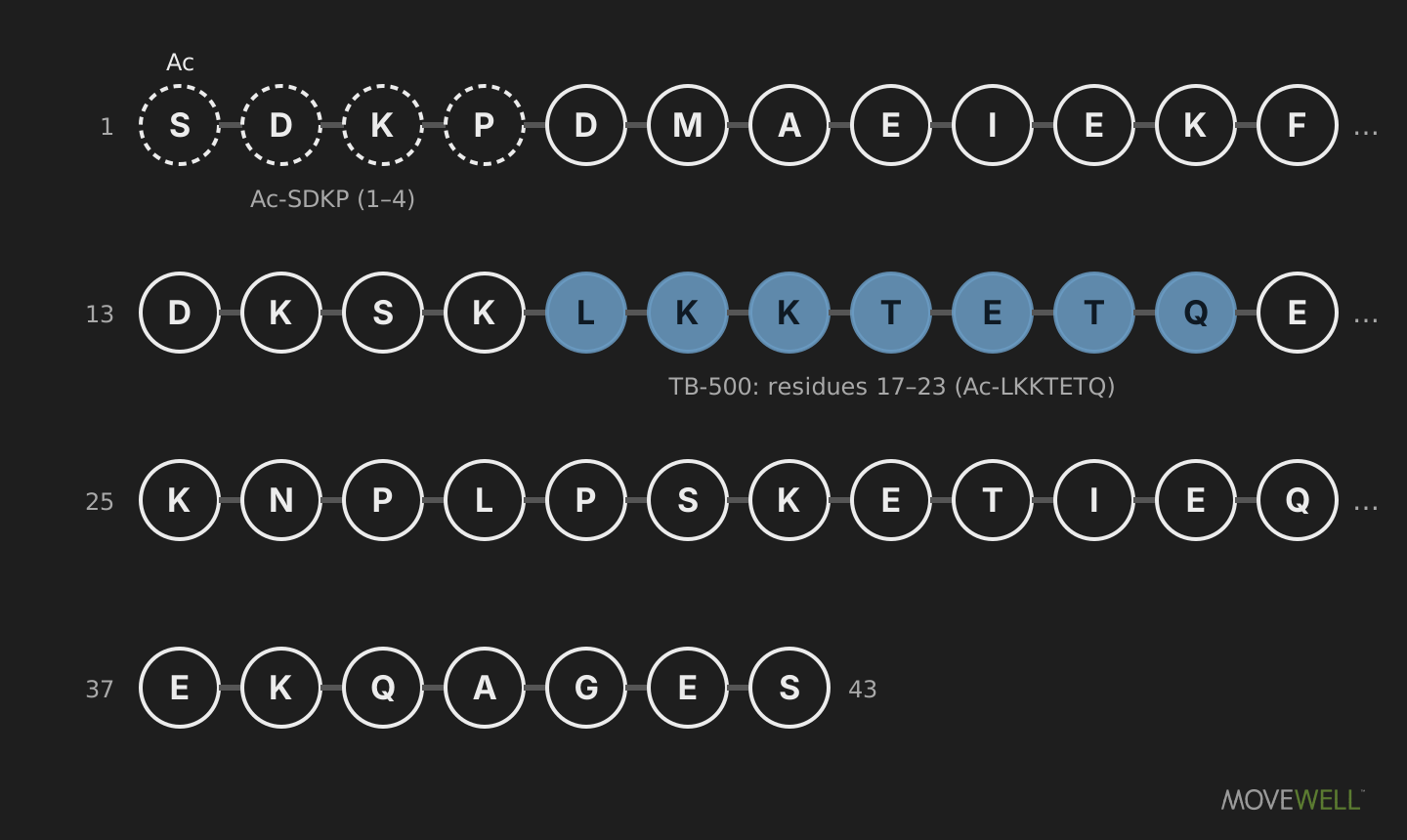
Thymosin beta-4 is a natural 43-amino-acid protein found in almost every cell. TB-500, as FDA defines it, is a synthetic copy of a 7-amino-acid piece of it, and FDA says the two "are not the same substance."1 Some websites use the two names interchangeably, so a label alone doesn't tell you which one a product claims to be.1, 29 Unlike TB-500, full-length thymosin beta-4 has been tested in people: as eye drops for dry eye and corneal ulcers, as a skin gel for wounds and by IV.7, 16, 20 Safety looked clean, but three dry-eye trials and two corneal ulcer trials missed their main goals, and two skin-ulcer trials found no significant healing benefit.7, 12, 33, 16, 17 A third corneal ulcer trial, SEER-2, has finished, with results due.13 No trial has tested it for muscle or tendon injuries. Because it is longer than 40 amino acids, it meets FDA's definition of a protein, and protein drugs can't be compounded under the usual pharmacy exemptions.3, 4 What is sold online as "TB4" is a research chemical.
Looking for the 7-amino-acid fragment? See our TB-500 guide. See every peptide's status in the regulatory tracker
In this guide
At a glance
| What it is | A natural 43-amino-acid protein that holds actin, a building block of the cell skeleton1, 2 |
|---|---|
| Not the same as | TB-500, a synthetic 7-amino-acid piece (residues 17–23). FDA: "not the same substance"1 |
| Best evidence | Phase 3 eye-drop trials in dry eye (over 1,600 people) and corneal ulcers. Primary goals missed7, 12, 33 |
| Approved in | Nowhere, in the sources we reviewed7, 13, 29 |
| No good evidence for | Tendon, muscle or joint injuries, hair, or general recovery in people |
| Legal status | Not FDA-approved. A protein under FDA's definition, so not compoundable. Not in the 2026 HHS peptide policy3, 4, 5 |
| In sport | Banned at all times. WADA S2.3 names "Thymosin-β4 and its derivatives e.g. TB-500"28, 29 |
| Main risks | Trial side effects were mild. Unknown purity of online products. A theoretical cancer concern from lab data11, 20, 27 |
| Typical cost | No legal US source, so no price |
Where to get it
MoveWell sells no peptides and links only to legal options. All options
The only lawful way to receive it in the US is in a trial. SEER-2 has finished enrolling.13, 14
StatusMolecular structure
A chain of 43 amino acids, too large to draw atom by atom here. This schematic shows the sequence. TB-500 copies residues 17 to 23 and adds an acetyl cap.
Residues 17 to 23, the stretch TB-500 copies
- Length
- 43 amino acids, acetylated at the start
- Formula
- C212H350N56O78S
- Weight
- 4,963.5 g/mol
- UniProt
- P62328 (gene TMSB4X)
- TB-500
- Residues 17–23, Ac-LKKTETQ
- Ac-SDKP
- Residues 1–4
Sequence from UniProt P62328, with the starting methionine removed, as in the mature protein.2 Formula and weight are our calculation from that sequence plus the N-terminal acetyl group. Outlined residues 1 to 4 form Ac-SDKP, a separate natural fragment.32
What it is
Thymosin beta-4 was first isolated from calf thymus. FDA describes it as a "full-length (43-amino acid) peptide" that is "ubiquitously expressed" and found in blood, saliva, tears and wound fluid.1 Inside cells it binds single actin units and stops them from joining into filaments.2
Two smaller pieces of it are sold or studied on their own:
- TB-500. A synthetic copy of residues 17 to 23 with an acetyl cap. FDA says websites "often use the terms interchangeably," but the two are different substances, and FDA found no study in which TB-500 was given to people.1 Australia's anti-doping agency lists "TB-500" as another name for thymosin beta-4, and WADA bans both under one entry, so a vial labeled TB-500 may claim to be either.28, 29 See our TB-500 guide.
- Ac-SDKP. Residues 1 to 4, released naturally from the protein and broken down by the blood-pressure enzyme ACE.32
US developer RegeneRx built three products on full-length thymosin beta-4: RGN-259 eye drops, RGN-137 skin gel and RGN-352 for injection.7, 19 Its eye-drop partner ReGenTree, a US subsidiary of Korea's HLB Therapeutics, runs the eye trials.13 In China, a recombinant version called NL005 is in heart-attack trials.22, 24
How it works
Most of what's known comes from cells and animals.
- Actin and cell movement. By holding actin, it helps control cell shape and movement. FDA names residues 17 to 22 (LKKTET) as its actin-binding region.1, 2
- Wound closure in rats. On the skin or by injection, it sped skin wound healing by 42% at day 4 and up to 61% at day 7, with more new blood vessels.25
- Heart in mice. After a blocked heart artery, it improved heart-cell survival and heart function.26
- Cornea. RegeneRx's eye program rests on its claimed ability to protect the cornea and help it heal.13
In people, an IV study in healthy volunteers found blood levels rose in line with the dose.20 That tells us how it is handled, not whether it heals anything.
Evidence map
Each use is graded separately. These grades are for full-length thymosin beta-4. TB-500 has its own page and lower grades.
Three phase 3 trials with over 1,600 people. All missed their main goals, with some secondary signals
Two phase 3 trials missed their main goal: a small US trial that closed early, and a European trial (SEER-3) in 2025. SEER-2's results are due
Phase 2 trials in leg, pressure and blistering-skin ulcers. Healing not significantly better than placebo
Mouse data. Two Chinese phase 2 trials finished with no results posted. The US trial was withdrawn
No human study. The online claims borrow from rat wound and mouse heart studies
Scale: 5 FDA-approved, 4 strong human, 3 limited human, 2 animal or lab only, 1 anecdotal
Key studies
| Use | Study | Model | Finding |
|---|---|---|---|
| Dry eye | ARISE-1, 20168 | Phase 2/3 n=317 | Primary goals not met. Less discomfort at day 28 in a secondary test. No drug-related serious side effects |
| Dry eye | ARISE-2, 20179, 10 | Phase 3 n=601 | Sponsor: "not successful in duplicating the results of ARISE-1." FDA asked for another trial |
| Dry eye | ARISE-3, 202111 | Phase 3 n=700 | "Did not meet its primary outcome measures." Grittiness improved. Mild eye pain on dosing in 6.6% vs 4.6% |
| Corneal ulcers | SEER-1, Sosne 202312 | Phase 3 n=18, closed early | Healed at 4 weeks: 6 of 10 vs 1 of 8 on placebo. Not significant on the main test (p=0.0656) |
| Corneal ulcers | SEER-3, Europe, 202533, 34 | Phase 3 about 70 | Missed its main goal, complete healing at 4 weeks. Sponsor cited a high placebo response. No numbers released |
| Corneal ulcers | SEER-213, 15 | Phase 3 about 70 planned | Sponsor: 50 sites in the US and Europe. Last patient visit announced Aug 2026. Results not announced by November 2, 2026 |
| Leg ulcers | RGN-137 gel, 200916 | Phase 2 n=72 | Healed: 33% on the middle dose vs 24% on placebo. "Not deemed to be statistically significant" |
| Pressure ulcers | RGN-137 gel17 | Phase 2 n=72 | Safe. No significant difference from placebo in complete healing |
| Blistering skin (EB) | RGN-137 gel18, 19 | Phase 2 n=30 | Sponsor reports better healing and no serious side effects. No peer-reviewed results found |
| Safety | Ruff 201020 | Phase 1 40 healthy adults | IV doses. Side effects "infrequent and mild or moderate." No serious events |
| Heart attack | NL005, China22, 23 | Phase 2 n=62 and n=90 | Both completed. No results posted or published that we found. A larger trial is planned24 |
| Heart attack | RGN-352, US21 | Phase 2 withdrawn | Planned IV trial after heart attack. Withdrawn, with no results |
RegeneRx says its three dry-eye trials showed significant effects in some subgroups, but FDA said that was not enough to support approval.7 Most of these results come from sponsor press releases, not peer-reviewed papers.
By goal
Pick your goal to see what the evidence supports.
| Thymosin beta-4 | TB-500 | |
|---|---|---|
| Size | 43 amino acids, a protein | 7 amino acids, a peptide |
| Human trials | Eye, skin and IV trials, mostly missed goals | None |
| HHS policy | Not covered | Acetate, by injection |
| Legal US source | Clinical trials only | Compounding pharmacy under the HHS policy, with a prescription |
How it's used
We don't give a dose. No dose has been approved for any use.
In trials it was given as eye drops, a gel on wounds or an IV infusion.7, 16, 20 Online it is sold as a powder for injection under the skin, a route no published efficacy trial has tested. We report this as information, not instruction.
Side effects and who should avoid it
- In trials, mild. In an IV study of 40 healthy adults, some given placebo, side effects were "infrequent and mild or moderate," with no serious events.20 In the largest dry-eye trial, the most common eye side effect was mild pain when the drops went in.11 The skin gel trials reported no drug-related serious side effects.16, 17
- Cancer, in theory. No study shows it causes cancer. But it is often highly expressed in some tumors, and in breast cancer samples higher levels went with spread to lymph nodes. That link is a correlation only.27 It also promotes new blood vessels in animals.25 People with cancer should talk to their oncologist.
- Online products. Research vials have no FDA quality checks, and FDA found identity problems even in material submitted for TB-500's review.1, 31
- Unknowns. No published trial has tested repeated injections under the skin for months.
- Who should avoid it. Tested athletes, since it is banned at all times.28 Anyone pregnant or breastfeeding, since there is no safety data.
Compared with
| Thymosin beta-4 | TB-500 | BPC-157 | |
|---|---|---|---|
| What it is | Natural 43-amino-acid protein | Synthetic copy of a 7-amino-acid piece of Tβ4 | 15-amino-acid peptide from stomach juice |
| Human trials | Yes: eye, skin, IV. Mostly missed goals | None | Very few, small |
| US compounding | No: a protein | Under HHS policy, injection | Under HHS policy |
| WADA | Banned, S2.3 | Banned, S2.3 | Banned, S0 |
Sources: FDA,1 HHS Appendix B,5 WADA.28 See our TB-500 and BPC-157 guides, and BPC-157 vs TB-500.
Stacks
The "Wolverine" stack pairs BPC-157 with TB-500, not with full-length thymosin beta-4, and some sellers swap the names. We found no study of thymosin beta-4 combined with BPC-157. Any blend is outside the HHS policy, which allows one active ingredient per product.5 See our Wolverine stack guide.
Myths vs evidence
All options
MoveWell sells no peptides. Checked November 1, 2026
Clinical trials
The SEER-2 trial of RGN-259 eye drops for neurotrophic keratopathy ran at US and European sites and has finished.13, 15 A European corneal trial, SEER-3, missed its main goal in 2025.33 The sponsor says it is preparing another dry-eye trial, ARISE-4.13 Search ClinicalTrials.gov for "thymosin beta 4" or "RGN-259" for open studies.
Licensed compounding, with a prescription
None. Since March 23, 2020, a chain of more than 40 amino acids counts as a protein, and FDA treats protein drugs as biological products.3 FDA says biological products "are not eligible for the exemptions for compounded drugs under sections 503A and 503B."4 Thymosin beta-4 is also not one of the six peptides in the Oct 2026 HHS policy.5 In 2022 FDA framed its feedback on the dry-eye program around a biologics license application, the approval route for biological products.7 Telehealth pages offering "TB4" have no lawful product to fill it with, so we don't link them.
Research use only products
We don't list sellers. In August 2026 FDA warned five peptide sellers that a "research use only" label doesn't excuse products clearly meant for people.31
Legal status history
Newest first.
- Current statusNot approved in the US or, as far as we found, anywhere else. Investigational in eye trials. Not compoundable. Banned in sport.4, 13, 28
- SEER-2 topline results, which the sponsor expected about two to three months after the last patient visit.13, 14
- HHS peptide policy covers TB-500 acetate by injection. Full-length thymosin beta-4 is not included.5
- Sponsor announces SEER-2's last patient visit. It says the trial ran at 50 sites in the US, Italy, Spain and Poland.13
- FDA's compounding list names only the TB-500 fragment, as "nominated but withdrawn." Full-length thymosin beta-4 does not appear.6
- SEER-3, a European phase 3 trial in neurotrophic keratopathy, misses its primary endpoint.33, 34
- SEER-2 starts dosing.15
- ARISE-3, the third dry-eye phase 3, misses its primary outcomes.11
- FDA's protein definition takes effect: over 40 amino acids is a biological product, outside compounding exemptions.3, 4
- Sport's top court bans 34 Essendon players for thymosin beta-4 use.30
See every peptide's status in the regulatory tracker.
FAQ
Is thymosin beta-4 the same as TB-500?
No. Thymosin beta-4 is the natural 43-amino-acid protein. TB-500, as FDA defines it, is a synthetic copy of a 7-amino-acid piece of it. Some sellers use the names interchangeably, but FDA says they are not the same substance.
Is it FDA-approved?
No. Its eye drops are in phase 3 trials. It isn't approved for any use in the sources we reviewed.
Can I get it from a compounding pharmacy?
No. At 43 amino acids it counts as a protein, and FDA doesn't let pharmacies compound protein products under the usual exemptions. TB-500, the small fragment, is a different case.
Does it help tendon or muscle injuries?
Not shown. No human study has tested it for those. The trials were in eye and skin disease, and most missed their main goals.
What dose do people use?
We don't give one. No dose is approved for any use.
Can athletes use it?
No. WADA bans thymosin beta-4 and its derivatives at all times.
Does it cause cancer?
Not shown. The concern comes from lab findings that tumors often carry high levels, which is a correlation, not proof of harm.
References
34 sources, with links
- FDA. Review memo: TB-500-related bulk drug substances (May 15, 2026). Pharmacy Compounding Advisory Committee, Jul 23–24, 2026. fda.gov
- T3DB. Thymosin beta-4 (UniProt P62328). Link
- FDA. Definition of the term "biological product." Final rule. 85 FR 10057 (Feb 21, 2020), 21 CFR 600.3(h)(6). govinfo.gov
- FDA. Notice to compounders: changes that affect compounding on March 23, 2020. fda.gov
- HHS. 503A peptide enforcement discretion policy, Appendix B. hhs.gov
- FDA. Certain bulk drug substances for use in compounding that may present significant safety risks (current as of Apr 22, 2026). fda.gov
- BioSpace. RegeneRx eyes pipeline shuffle in light of development delays (Aug 22, 2022). Link
- RegeneRx/ReGenTree. RGN-259 confirms efficacy in signs and symptoms of dry eye (sponsor release, May 6, 2016). Link
- RegeneRx. RegeneRx JV announces results of ARISE-2 dry eye trial (sponsor release, Oct 31, 2017). Link
- RegeneRx. Outcome of FDA discussions for development of RGN-259 for dry eye syndrome (Apr 9, 2018). Link
- American Pharmaceutical Review. ARISE-3 dry eye trial does not meet primary outcome measures (Mar 2021). Link
- Sosne G et al. 0.1% RGN-259 (thymosin β4) ophthalmic solution promotes healing and improves comfort in neurotrophic keratopathy patients in a randomized, placebo-controlled, double-masked phase III clinical trial. Int J Mol Sci 2023;24(1):554 (online Dec 2022). PMID 36613994. Link
- Edaily. HLB Therapeutics' ReGenTree completes last patient visit in SEER-2 phase 3 of RGN-259 (Aug 26, 2026). Link
- Asia Business Daily. HLB Therapeutics completes global phase 3 patient enrollment for RGN-259 (Jul 20, 2026). Link
- SEER-2 (RGN-259 for neurotrophic keratopathy), NCT05555589 (registry mirror). Link
- FierceBiotech. RegeneRx reports Phase II venous stasis trial results (Mar 26, 2009). Link
- FierceBiotech. RegeneRx reports Phase II pressure ulcer trial results (2008). Link
- RegeneRx. Results of phase 2 clinical trial in patients with epidermolysis bullosa (sponsor release, Jun 24, 2013). Link
- Epidermolysis Bullosa News. RegeneRx, GtreeBNT provide update on RGN-137 for treatment of epidermolysis bullosa (Nov 5, 2018). Link
- Ruff D et al. A randomized, placebo-controlled, single and multiple dose study of intravenous thymosin β4 in healthy volunteers. Ann N Y Acad Sci 2010;1194:223–9. PubMed
- RGN-352 in acute myocardial infarction, NCT01311518, withdrawn (registry mirror). Link
- NL005 acute myocardial infarction phase 2a, NCT05485818 (registry mirror). Link
- NL005 acute myocardial infarction phase 2b, NCT05984134 (registry mirror). Link
- NL005 acute myocardial infarction phase 2c, NCT07586865 (registry mirror). Link
- Malinda KM et al. Thymosin β4 accelerates wound healing. J Invest Dermatol 1999;113(3):364–8. PMID 10469335
- Bock-Marquette I et al. Thymosin β4 activates integrin-linked kinase and promotes cardiac cell migration, survival and cardiac repair. Nature 2004;432:466–472. Link
- Yoon SY et al. Thymosin β4 expression correlates with lymph node metastasis through HIF-α induction in breast cancer. Oncol Rep 2011;25(1):23–31. Link
- World Anti-Doping Agency. 2026 Prohibited List, S2.3 (copy hosted by SEGAS). PDF
- Sport Integrity Australia. Thymosin beta-4. Link
- AFL.com.au. Guilty: court bans the Essendon 34 for 2016 (Jan 12, 2016). Link
- ArentFox Schiff. RUO-ined: five peptide vendors learn research use only is not a legal strategy (Aug 2026). Link
- Cavasin MA et al. Prolyl oligopeptidase is involved in release of the antifibrotic peptide Ac-SDKP. Hypertension 2004;43:1140. PMID 15037553
- Ophthalmology Times. HLB Therapeutics misses primary end point in phase 3 SEER-3 trial of RGN-259 (Jul 1, 2025). Link
- Pharm Edaily. HLB Therapeutics' fifth RGN-259 phase 3 failure (Jun 27, 2025, in Korean). Link
This page is for education and is not medical advice. Thymosin beta-4 is not FDA-approved. Talk to a clinician before using any peptide.