AOD-9604
Also called AOD9604, Tyr-hGH(177–191), a growth hormone fragment1
AOD-9604 is a 16-amino-acid piece of human growth hormone, made in the 1990s as an obesity pill. Its developer, Metabolic Pharmaceuticals in Australia, tested it in six human trials. The largest, which randomized 502 adults for 24 weeks, found no significant weight loss beyond placebo, and the company stopped development in February 2007.1 It later called the peptide "generally recognized as safe" for food, but that was its own expert panel's view, not an FDA decision.11 In 2024 FDA's advisers voted 0–12 against letting pharmacies compound it.2 It is still sold online, mostly as injections, a route never tested in a published human trial.1
See every peptide's status in the regulatory tracker
In this guide
At a glance
| What it is | A synthetic 16-amino-acid peptide: the tail end of human growth hormone (amino acids 177 to 191) with a tyrosine added1 |
|---|---|
| Forms | Free base and acetate salt. Sold online as injections, tablets and creams1 |
| Best evidence | A 24-week trial in 502 adults with obesity, by mouth: no difference from placebo1 |
| Approved in | Nowhere1, 14 |
| No good evidence for | Weight or fat loss, cartilage repair in people, muscle, anti-aging1, 3 |
| Legal status | Not FDA-approved. No legal compounding path. Not in the HHS peptide policy2, 7 |
| In sport | Banned at all times. WADA names it as a growth hormone fragment13 |
| Main risks | Unknown long-term safety. FDA flags immune reactions, cancers reported in one trial, and bone and liver findings in animals1, 3 |
| Typical cost | No legal US source, so no price we can list |
Where to get it
MoveWell sells no peptides. Some links may earn us a commission, which never decides what's listed or the order. All options and prices
No approved product exists, FDA's advisers voted against compounding it, and the HHS policy doesn't cover it.2, 7
Why"Research use only" products aren't checked for purity or dose. FDA has said that label doesn't excuse products meant for people.17
WhyFDA noted several approved drugs treat obesity. See our semaglutide and tirzepatide guides.3
CompareMolecular structure
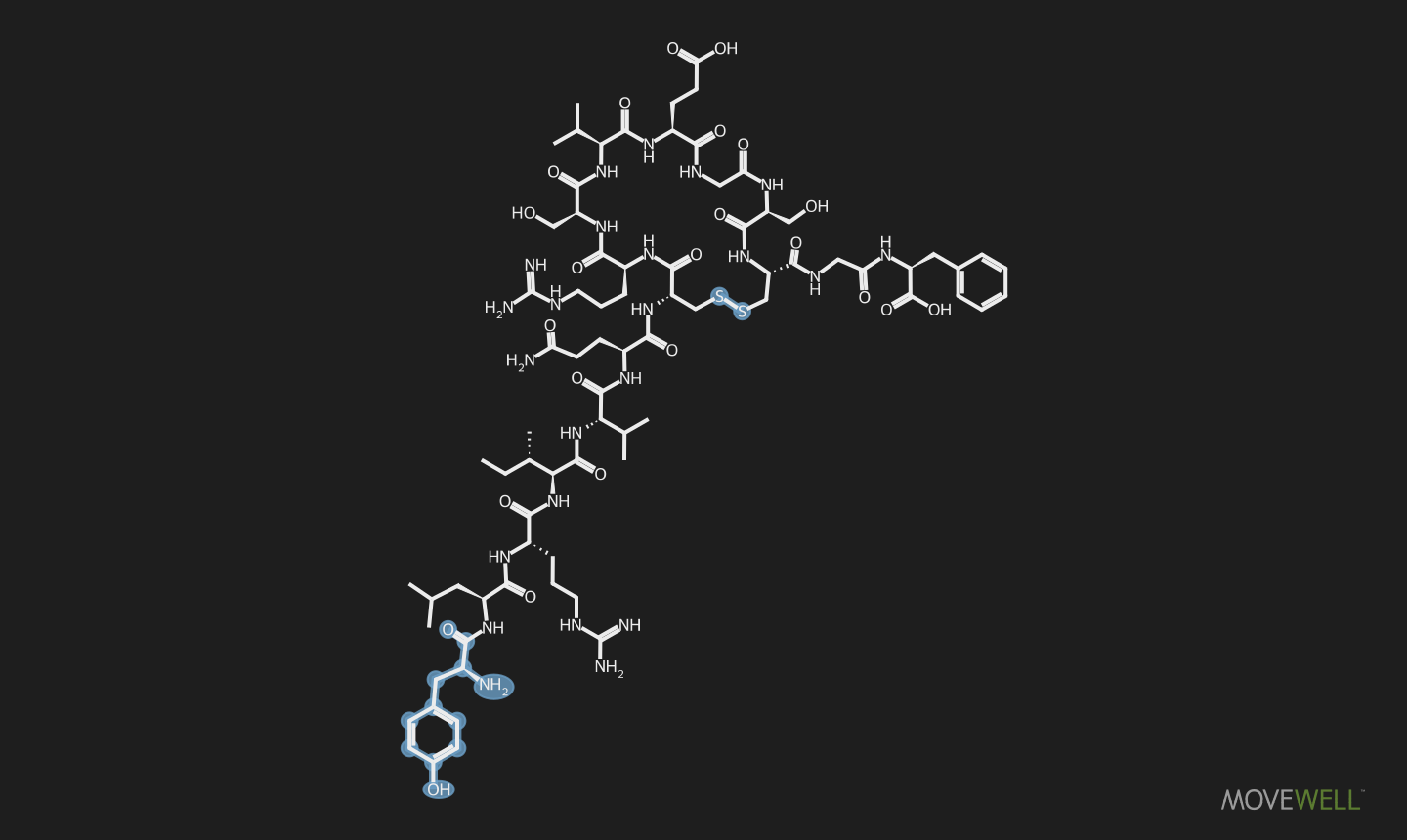
A chain of 16 amino acids. A bond between two cysteines closes the middle into a loop. The first amino acid, a tyrosine, was added to the growth hormone piece.
The added tyrosine (residue 1) and the disulfide bond
- Sequence
- YLRIVQCRSVEGSCGF
- Length
- 16 amino acids
- Loop
- Disulfide bond, Cys7 to Cys14
- Formula
- C78H123N23O23S2
- Weight
- 1,815.1 g/mol
- Acetate
- C80H127N23O25S2, 1,875.1 g/mol
- CAS
- 221231-10-3
- FDA UNII
- 7UP768IP4M (free base)
Drawn from the sequence, with the disulfide bond, as FDA describes it. Formula, weight, CAS and UNII are FDA's; the formula we computed matches.1
What it is
Growth hormone breaks down stored fat, among many other effects. In the 1990s, Australian researchers looked for the part of the hormone that drives fat loss, and settled on a piece of its last 15 amino acids. Metabolic Pharmaceuticals developed AOD-9604 from that piece, with a tyrosine added at the start.1, 10 FDA describes it as a "synthetic 177-191 fragment (15 amino acids) of hGH" with a tyrosine added.1
The aim was an obesity drug with growth hormone's effect on fat but without its effects on growth or blood sugar. The company tested it by vein and by mouth. When its largest trial failed in 2007, it said the results did "not support the commercial viability of the drug as a treatment for obesity."1
The company then turned to food. In 2012 it announced a "self-affirmed conditional GRAS status" from a panel of US experts it convened, for use in foods, drinks and dietary supplements at up to 1 mg a day per person.11 In 2014 a trade report said it had been designated GRAS for the same uses.12 GRAS covers food ingredients, not injected drugs, and neither report describes an FDA review.11
WADA also names "hGH 176-191," a near-identical growth hormone fragment sold online under names such as Frag 176-191.13 It is a different molecule, and we found no human trial of it.
How it works
What's known comes from animal and lab work. FDA notes its molecular target is unknown.1
- Fat breakdown in rodents. In obese rats and mice it cut fat-making, raised fat breakdown and burning, and slowed weight gain.1
- A fat-cell receptor. In obese mice it raised levels of the beta-3 adrenergic receptor, which fat cells use to release fat. In mice lacking that receptor, long-term treatment didn't cause weight loss.10
- Not growth hormone's receptor. Its developers reported it doesn't bind the growth hormone receptor.1
- IGF-1. The developer reported no change in IGF-1 in its human trials.8 FDA found no animal data to support the claim that it doesn't raise IGF-1.1
No study has measured how the human body absorbs or clears it. In pigs, it lasted about 3 minutes in the blood after an IV dose.1
Evidence map
Each claimed use is graded separately, because the evidence differs by use.
Placebo-controlled trials in about 900 people. The largest and longest found no benefit
One study in 32 rabbits with injected knees. No human study
No studies found. Online claims only
Scale: 5 FDA-approved, 4 strong human, 3 limited human, 2 animal or lab only, 1 anecdotal. Weight loss scores 3 for the amount of human testing, not for results: the results were negative.
Key studies
| Use | Study | Model | Finding |
|---|---|---|---|
| Weight | OPTIONS trial, 2007, via FDA1 | Human RCT n=502, 24 weeks | Daily by mouth, plus diet and exercise. No significant difference from placebo on the main weight-loss measure. Development stopped |
| Weight | Herd 2005 abstract, via FDA1 | Human RCT about 300, 12 weeks | Daily by mouth. FDA called the differences small, of unclear meaning, and never fully published |
| Weight | Wilding 2004, via FDA1 | Human n=23, 4 weeks | Weekly IV doses in adults with obesity. Weight loss not significant vs placebo |
| Weight | Wilding 2004, via FDA1 | Human n=36 men, 1 week | Doses for one week; FDA's summary doesn't give the route. 1 kg lost on the lowest dose vs 0.6 kg on placebo |
| Safety | Stier 20138 | 6 human RCTs | Developer's summary: side effects "indistinguishable from placebo," no IGF-1 change, no antibodies in those tested |
| Fat | Heffernan 200110 | Mouse 14 days | Lower body weight and fat in obese mice. No long-term effect in mice lacking the beta-3 receptor |
| Cartilage | Kwon 201516 | Rabbit n=32 | Knee injections after induced arthritis. Better cartilage scores than saline, best with hyaluronic acid |
FDA found no AOD-9604 study on ClinicalTrials.gov.1 The developer sponsored the trials, and its safety and toxicity papers list the company as sponsor and include a company author.8, 9 FDA concluded there is a "lack of evidence to support the effectiveness of AOD-9604" for obesity.1
By goal and route
Pick your goal to see what the evidence supports.
| By mouth | Injection | Cream | |
|---|---|---|---|
| Legal status | No legal source | No legal source | No legal source |
| Human evidence | Trials up to 24 weeks: no clear weight loss | No published trial under the skin. IV trials found no significant loss | None |
| Known risks | Short trials only; FDA flags cancers reported in one | FDA cites immune reactions, especially by injection | No data |
| Cost | No legal source | No legal source | No legal source |
Sources: FDA briefing and slides,1, 3 advisory vote,2 HHS policy.7
How it's used
We don't give a dose. No dose worked in trials, and none has been approved.
The trials gave it by vein or by mouth.1 Clinics and websites sell it mainly as injections under the skin, and also as dissolving tablets.1 FDA found no human exposure by injection under the skin or through the skin.1 We report this as information, not instruction.
Side effects and who should avoid it
- Short trials only. The longest lasted 24 weeks. FDA said there is "insufficient information to support the long-term use of AOD-9604."3
- Reported side effects. FDA's summary of the trials lists headache, fatigue, low blood sugar and dizziness in a small IV study, spread similarly between drug and placebo, and chest tightness and diarrhea as serious events.1, 3
- Cancers. In the 12-week oral trial, five people had serious events, including basal cell and squamous cell skin cancers. Investigators judged none related, but FDA said it has "concerns about the reports of various cancers."1
- Animal findings. In rats, bone-marker changes that FDA said could suggest harm to bone. In monkeys, liver-cell changes in all high-dose females. DNA-damage tests were equivocal or positive, signals FDA said "cannot be regarded as biologically insignificant."1 The developer's own paper judged these findings not significant.9
- Immune reactions. FDA "cannot rule out the potential for immunogenicity," especially by injection, because of impurities and clumping in peptide products.1, 6
- Sterility. In 2021 a US compounder recalled lots of injectable AOD-9604, and of one other injectable peptide, over a lack of sterility assurance.15
- Who should avoid it. No label exists. It has not been studied in pregnancy, breastfeeding, children, or people with cancer, diabetes or liver disease. Anyone tested in sport should avoid it.13
FDA found no adverse event reports for AOD-9604 in its databases, and said that "does not imply that the substance is safe."1
Compared with
| AOD-9604 | Tesamorelin | |
|---|---|---|
| What it is | A fragment of growth hormone | A copy of the hormone that releases growth hormone (GHRH) |
| FDA status | Not approved. Advisers voted 0–12 against compounding | Approved, as Egrifta WR, to reduce excess belly fat in adults with HIV |
| Fat in trials | No significant weight loss beyond placebo | Less deep belly fat in its approved group. The label says it is not for weight loss |
| IGF-1 | Developer reports no rise | Rises; the label asks doctors to monitor it |
Sources: FDA briefing,1 advisory vote,2 developer's safety paper,8 Egrifta WR label.18 See our tesamorelin, MK-677 and sermorelin guides for drugs that raise growth hormone itself.
Stacks
Online sellers sometimes pair AOD-9604 with other growth hormone peptides, such as CJC-1295 or ipamorelin. We found no study of any combination. None of these is covered by the HHS policy, which in any case allows one active ingredient per product.5, 7
Myths vs evidence
All options and prices
MoveWell sells no peptides. Some links may earn us a commission; that never decides what's listed or the order. Checked November 1, 2026
Licensed compounding, with a prescription
None. FDA's advisers voted 0–12 against adding AOD-9604 to the compounding list, and the HHS policy of October 28, 2026 doesn't include it.2, 7 We found no provider in our checks offering it through a lawful route.
Foods and supplements
The company's GRAS claim was for foods, drinks and dietary supplements.11 We found no US food or supplement containing it that we could confirm is lawfully sold, so we list none.
Research use only products
We don't list sellers. These products are unapproved drugs when they're meant for people. In August 2026 FDA warned five peptide sellers that a "research use only" label is no defense.17
Legal status history
Newest first.
- Current statusNot FDA-approved and not approved anywhere. No legal US compounding path. Banned in sport at all times.2, 7, 13
- No FDA review, rule or trial is scheduled that we could find.
- HHS enforcement discretion policy covers six peptides. AOD-9604 is not one of them.7
- FDA's safety-risk page lists AOD-9604 under nominations withdrawn, noting it "may pose significant risk for immunogenicity."6
- FDA's compounding advisory committee votes 0–12 against both forms, for obesity, with no discussion.2, 4
- FDA staff review recommends against: poorly characterized, no evidence it works, limited safety data.1
- Removed from Category 2 after both nominators withdrew. FDA reviewed it anyway, on its own initiative.1, 5
- A US compounder recalls lots of injectable AOD-9604 over a lack of sterility assurance.15
- A trade report says the developer has US GRAS status for foods, drinks and supplements.12
- WADA confirms AOD-9604 is banned in sport, as a substance not approved anywhere.14
- The developer announces a "self-affirmed conditional GRAS status" from its own expert panel.11
- Development as an obesity drug ends after the 24-week trial fails.1
Australia's medicines scheduling committee recommended listing it with performance and image enhancing drugs, which can't be possessed without authority.1 See every peptide's status in the regulatory tracker.
FAQ
Is AOD-9604 legal in the US?
It isn't approved, and pharmacies can't legally compound it. FDA's advisers voted 0–12 against it in 2024, and the 2026 HHS peptide policy doesn't cover it. Products sold "for research" aren't legal for people to use as drugs.
Is it FDA-approved?
No, and it isn't approved anywhere. Its developer stopped work on it as an obesity drug in 2007.
Does it cause weight loss?
Not in its main trials. The largest, in 502 adults over 24 weeks, found no difference from placebo.
Isn't it GRAS?
The company said so, based on a panel it convened, for foods, drinks and supplements up to 1 mg a day. That isn't an FDA approval, and it doesn't apply to injections.
What dose do people use?
We don't give one. No dose worked in trials.
Can athletes use it?
No. WADA bans it at all times as a growth hormone fragment.
Is it the same as Frag 176-191?
Close but not identical. Both are pieces of the end of growth hormone. WADA bans both, and we found no human trial of Frag 176-191.
References
18 sources, with links
- FDA. FDA briefing document: AOD-9604-related bulk drug substances, Section 503A bulk drug substances list (Nov 5, 2024). Pharmacy Compounding Advisory Committee, Dec 4, 2024. fda.gov
- FDA. Pharmacy Compounding Advisory Committee, Dec 4, 2024: final meeting minutes. fda.gov
- FDA. Pharmacy Compounding Advisory Committee, Dec 4, 2024: FDA presentations, morning session (AOD-9604). fda.gov
- Federal Register. Pharmacy Compounding Advisory Committee; notice of meeting, Dec 4, 2024. 89 FR (Oct 25, 2024), FR Doc. 2024-24828. govinfo.gov
- Reed Smith. FDA removes certain peptide bulk drug substances from Category 2 of interim 503A bulks list and sets dates for PCAC review. Client Alert 2024-208. Link
- FDA. Certain bulk drug substances for use in compounding that may present significant safety risks (current as of Apr 22, 2026). fda.gov
- BakerHostetler. HHS issues enforcement discretion policy regarding 503A compounding using certain peptide bulk drug substances (Oct 28, 2026). Link
- Stier H, Vos E, Kenley D. Safety and tolerability of the hexadecapeptide AOD9604 in humans. J Endocrinol Metab 2013;3(1-2):7–15. DOI 10.4021/jem157w
- Moré MI, Kenley D. Safety and metabolism of AOD9604, a novel nutraceutical ingredient for improved metabolic health. J Endocrinol Metab 2014;4(3):64–77. DOI 10.14740/jem213w
- Heffernan M et al. The effects of human GH and its lipolytic fragment (AOD9604) on lipid metabolism following chronic treatment in obese mice and β3-AR knock-out mice. Endocrinology 2001;142(12):5182–5189. PMID 11713213
- Calzada Limited. ASX announcement: AOD9604 receives GRAS status in the US (Jun 25, 2012). asx.com.au
- Lab+Life Scientist. AOD9604 awarded safe status in US (Aug 6, 2014). Link
- World Anti-Doping Agency. 2026 Prohibited List, S2.2.3 (copy hosted by SEGAS). PDF
- World Anti-Doping Agency. WADA statement on substance AOD-9604 (Apr 2013; copy hosted by the International Weightlifting Federation). Link
- FDA. Innoveix Pharmaceuticals, Inc. issues voluntary recall of all sterile compounded drug products due to a lack of sterility assurance (Jul 13, 2021). fda.gov
- Kwon DR, Park GY. Effect of intra-articular injection of AOD9604 with or without hyaluronic acid in rabbit osteoarthritis model. Ann Clin Lab Sci 2015;45(4):426–432. PMID 26275694
- ArentFox Schiff. RUO-ined: five peptide vendors learn research use only is not a legal strategy (Sep 18, 2026). Link
- FDA. EGRIFTA WR (tesamorelin) for injection, prescribing information (revised 3/2025). DailyMed
This page is for education and is not medical advice. AOD-9604 is not FDA-approved. Talk to a clinician before using any peptide.