IGF-1 LR3
Also called Long R3 IGF-I, LR3-IGF-I, long-(Arg3) insulin-like growth factor-I1
IGF-1 LR3 is a lab-made, longer-acting version of IGF-1, the hormone that carries out much of growth hormone's effect. It has one amino acid swapped and 13 extra added, so the proteins that normally hold IGF-1 in check barely grip it. In rats that made it about 2.5 times as potent as IGF-1.2 It was made for laboratory research, and we found no study of it in people.4 The only approved IGF-1 drug is mecasermin (Increlex), which is plain human IGF-1, for children with a rare growth disorder. Its label warns about low blood sugar, which affected 42% of children in its trials.5 IGF-1 LR3 is sold online for muscle and fat loss without any of that testing.
See every peptide's status in the regulatory tracker
In this guide
At a glance
| What it is | Human IGF-1 (70 amino acids) with arginine in place of glutamic acid at position 3, plus a 13-amino-acid extension at the start: 83 amino acids in all1, 2 |
|---|---|
| Forms | Vials sold as a research reagent. Not made as a medicine anywhere4 |
| Best evidence | Rat studies from the early 1990s: more potent than IGF-1, with weight regained mostly as protein and more gut growth2, 3 |
| Approved in | Nowhere. Mecasermin, plain IGF-1, is approved for children with severe primary IGF-1 deficiency5 |
| No good evidence for | Muscle, fat loss, recovery or anti-aging in people2 |
| Legal status | Not FDA-approved. A protein, so not eligible for pharmacy compounding. Not in the HHS peptide policy7, 8, 10 |
| In sport | Banned at all times, as an IGF-1 analog11 |
| Main risks | Never measured in people. IGF-1's known risks include low blood sugar with seizures, raised pressure in the skull, swollen tonsils and a cancer warning5 |
| Typical cost | No legal US source, so no price we can list |
Where to get it
MoveWell sells no peptides. Some links may earn us a commission, which never decides what's listed or the order. All options and prices
Molecular structure
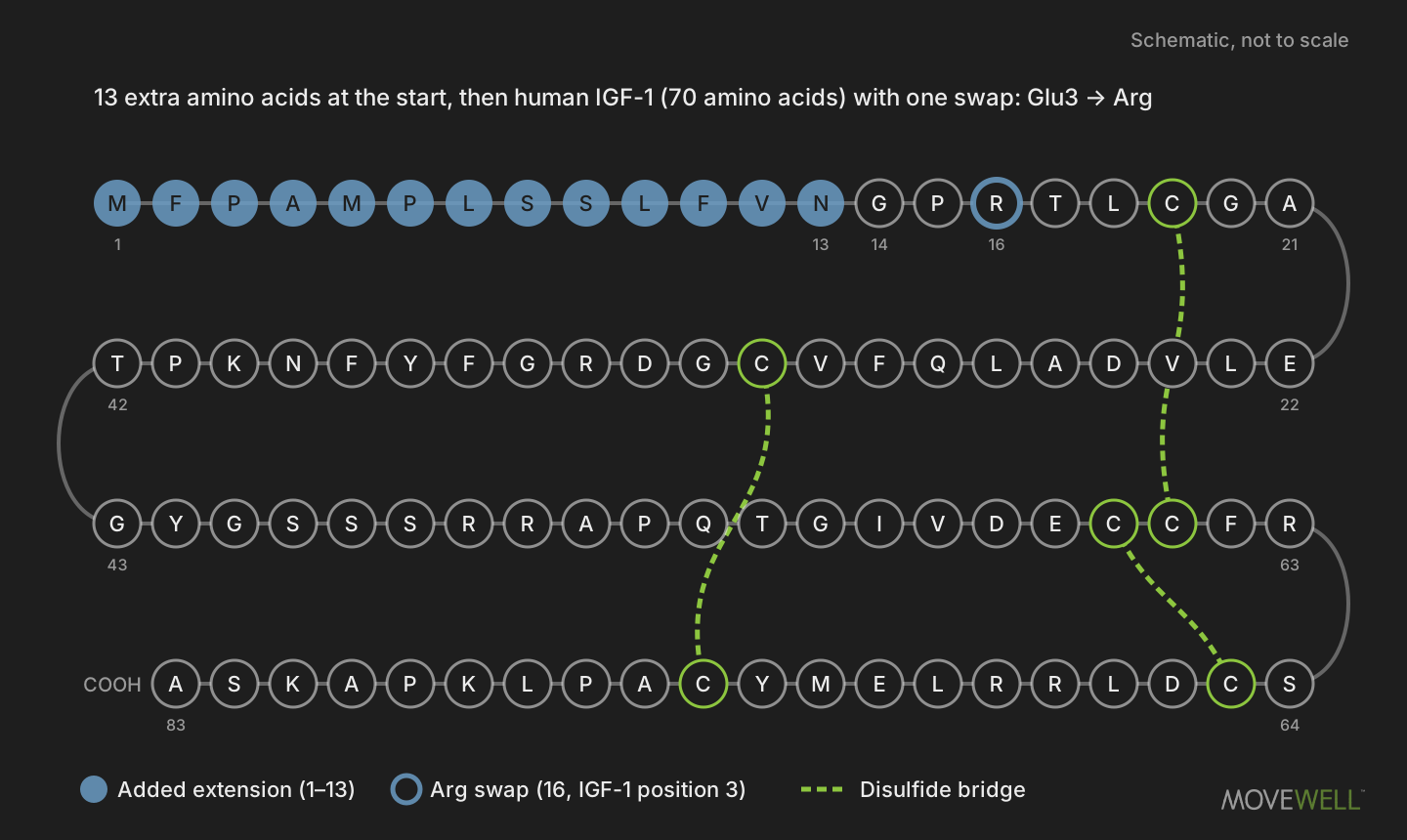
A protein of 83 amino acids: 13 added at the start, then human IGF-1 with one swap. Three disulfide bridges fold it. Too large to draw atom by atom, so this is a sequence diagram.
The added 13-amino-acid extension and the arginine swap
- Length
- 83 amino acids
- Extension
- MFPAMPLSSLFVN
- Swap
- Glu3 → Arg (the "R3")
- Bridges
- 3 disulfide bonds
- Formula
- C400H619N111O115S9
- Weight
- 9,111.6 Da
- CAS
- 143045-27-6
- FDA UNII
- M9L22Y19H9
FDA's substance record describes the extension as a modified version of the first 13 amino acids of pig growth hormone.1 Formula and weight are our calculation from the sequence with IGF-1's three disulfide bonds; FDA's record lists none. The same method gives 7,649 Da for mecasermin, matching its label.5
What it is
Growth hormone works largely through IGF-1, made mostly in the liver. In the blood, almost all IGF-1 is held by binding proteins, which limit how much reaches tissues. Australian researchers built variants that dodge those proteins. Long R3 IGF-I was one of them.2
It changes IGF-1 in two ways. Arginine replaces glutamic acid at position 3, and a 13-amino-acid extension is added to the front.1, 2 Its main use has been in research. A doping lab that analyzed a black-market vial noted that the tagged form it found is "usually produced for biochemical studies."4
The only approved IGF-1 medicine in the US is mecasermin, sold as Increlex. It is identical to human IGF-1 and was approved in 2005, when Ipsen held it; the current label names Eton Pharmaceuticals as manufacturer.5, 6 Its label limits it to children 2 and older with severe primary IGF-1 deficiency or growth hormone gene deletion with neutralizing antibodies, and says it "is not a substitute" for growth hormone.5
How it works
What's known comes from rat and lab studies.2, 3
- Escapes binding proteins. It binds IGF-binding proteins poorly, so more of it stays free to act.2, 3
- More potent despite a weaker grip. It binds the IGF-1 receptor about 3 times less well than IGF-1, yet in rats on steroids it was about 2.5 times as potent.2
- Lean tissue and gut. In those rats, IGF-1 cut muscle protein breakdown, the weight regained was mostly protein rather than fat, and IGF-1 and especially the variants raised gut weight by up to 45%.2
- Insulin-like effects. In rats with tumors, infused IGF lowered food intake, blood glucose and insulin.3 Human IGF-1 lowers blood sugar enough that its label requires dosing with a meal.5
We found no study that measured how long it lasts in the human body. Half-life figures quoted online are not from human data we could find.
Evidence map
Each claimed use is graded separately, because the evidence differs by use.
Rats given steroids or with tumors, over about a week. No human study
No study found. Online claims only
No study found. Online claims only
Never tested with LR3. Mecasermin, plain IGF-1, is the approved treatment
Scale: 5 FDA-approved, 4 strong human, 3 limited human, 2 animal or lab only, 1 anecdotal. The grades are for IGF-1 LR3, not mecasermin.
Key studies
| Use | Study | Model | Finding |
|---|---|---|---|
| Muscle | Tomas 19922 | Rat 7 days | In rats wasting on steroids, LR3 and another variant were about 2.5 times as potent as IGF-1. Gut weight up to 45% higher |
| Wasting | Tomas 19943 | Rat 6 to 7 days | In rats with tumors, LR3 alone didn't add body weight; with insulin it did. Glucose and insulin fell |
| Products | Kohler 20104 | Seized vial | A black-market injection vial held LR3 with a lab purification tag, a form never studied in people |
| Growth (mecasermin) | Increlex trials, via label5 | Human n=71 children | The basis for approval in severe IGF-1 deficiency. 42% had low blood sugar at least once |
| Any use | Human trials of LR3 | None | We found no published human study |
The rat studies came from the Australian group that designed the variants.2, 3 Results in mecasermin can't be assumed to apply to IGF-1 LR3, which behaves differently in the body.2
By goal and route
Pick your goal to see what the evidence supports.
| IGF-1 LR3 | Mecasermin (Increlex) | |
|---|---|---|
| Legal status | No legal source | FDA-approved, prescription only, for one rare condition in children |
| Human evidence | None found | Trials in 71 children with severe IGF-1 deficiency |
| Known risks | Never measured; purity and identity unchecked | Low blood sugar, raised skull pressure, swollen tonsils, hip and spine problems, a cancer warning |
| Cost | No legal source | Specialty drug; we have no verified price |
Sources: Increlex label,5 Kohler 2010,4 FDA compounding notice.8
How it's used
We don't give a dose. No human study has tested IGF-1 LR3, so no safe dose is known.
It is sold online in vials for injection.4 For comparison, the approved drug mecasermin is injected under the skin twice a day at a weight-based dose that starts low and rises slowly. The label says to give it within 20 minutes of a meal or snack, and to skip it if the patient can't eat, because of the risk of low blood sugar.5 We report this as information, not instruction.
Side effects and who should avoid it
No study has recorded IGF-1 LR3's side effects in people. The risks below are on the label of mecasermin, plain IGF-1, from trials in children.5 LR3 was more potent than IGF-1 in rats, so they shouldn't be assumed to be smaller.2
- Low blood sugar. 42% of children had it at least once, and 4 had seizures or lost consciousness. The label requires dosing with food.5
- Raised pressure in the skull. Reported in 3 of 71 children.5
- Swollen tonsils and adenoids. Tonsil enlargement in 15%, with snoring and ear infections among side effects.5
- Allergic reactions. Including anaphylaxis after approval, estimated at 0.3% of patients.5
- Cancer. The label warns about malignant tumors and rules out use with active cancer or a history of cancer in children.5
- Bones. Slipped hip growth plates and worsening scoliosis are listed warnings in growing children.5
- Unknown product. A doping lab found a black-market vial containing a tagged research form. Its effects in people have never been studied.4
- Who should avoid it. No label exists for IGF-1 LR3. Mecasermin's label rules it out with cancer or a past cancer in children, tells families to mention insulin or other diabetes medicines, and has no data in pregnancy or breastfeeding.5 Athletes subject to testing should avoid it.11
Low blood sugar can be dangerous. Shaking, sweating, confusion or a seizure needs urgent care: call 911.
Compared with
| IGF-1 LR3 | Mecasermin | Tesamorelin | |
|---|---|---|---|
| What it is | Modified IGF-1, 83 amino acids | Human IGF-1, 70 amino acids | Releases growth hormone, which raises IGF-1 |
| FDA status | Not approved | Approved (Increlex), children's growth disorder | Approved (Egrifta WR), belly fat in adults with HIV |
| Human trials | None found | Yes, in children | Yes, in adults with HIV |
| How IGF-1 rises | Acts as IGF-1 directly | Acts as IGF-1 directly | Through the body's own growth hormone |
Sources: FDA substance record,1 Increlex label,5 Egrifta WR label.13 See our tesamorelin, sermorelin and MK-677 guides for products that raise IGF-1 through growth hormone.
Stacks
IGF-1 LR3 is often discussed alongside growth hormone releasers such as MK-677, CJC-1295 or ipamorelin. We found no study of any combination. Each raises IGF-1 activity, so the blood-sugar and growth-related risks could add up. The HHS policy covers none of these and allows one active ingredient per product.10
Myths vs evidence
All options and prices
MoveWell sells no peptides. Some links may earn us a commission; that never decides what's listed or the order. Checked November 1, 2026
Licensed compounding, with a prescription
None. IGF-1 LR3 is a protein, and FDA says biological products aren't eligible for pharmacy compounding.7, 8 It's also not in the HHS policy of October 28, 2026.10
Approved IGF-1
Mecasermin (Increlex) is a prescription drug for children 2 and older with severe primary IGF-1 deficiency or a growth hormone gene deletion with neutralizing antibodies. It is not a substitute for IGF-1 LR3 or for growth hormone, and it isn't approved for adults.5 We don't link a seller: a child's endocrinologist prescribes it.
Research use only products
We don't list sellers. These are lab reagents, and FDA treats products like them as unapproved drugs when they're meant for people. In August 2026 FDA warned five peptide sellers that a "research use only" label is no defense.12
Legal status history
Newest first.
- Current statusNot FDA-approved and not approved anywhere. Not eligible for pharmacy compounding. Banned in sport at all times.7, 8, 11
- No FDA review, rule or trial is scheduled that we could find.
- HHS enforcement discretion policy covers six peptides. IGF-1 LR3 is not one of them.10
- FDA warning letters to five online peptide sellers reject the "research use only" defense.12
- IGF-1 LR3 does not appear on FDA's list of compounding ingredients with safety risks or withdrawn nominations.9
- FDA's rule that chains over 40 amino acids are proteins takes effect. Biological products can't be compounded under 503A or 503B. Increlex becomes a biologics license.6, 7, 8
- A German doping lab identifies tagged IGF-1 LR3 in a black-market vial.4
- FDA approves mecasermin (Increlex), plain IGF-1, for children's growth failure.6
- Australian rat studies report LR3 and a related variant are more potent than IGF-1.2
See every peptide's status in the regulatory tracker.
FAQ
Is IGF-1 LR3 legal in the US?
It isn't approved, and pharmacies can't compound it. It's sold as a lab reagent, and FDA says a "research use only" label doesn't make a product legal when it's meant for people.
Is it FDA-approved?
No. The only approved IGF-1 drug is mecasermin (Increlex), which is plain human IGF-1 for a rare growth disorder in children.
Does it build muscle?
It hasn't been tested in people. In week-long rat studies it was more potent than IGF-1 at reversing steroid-induced weight loss.
Why is low blood sugar a concern?
IGF-1 acts partly like insulin. In mecasermin's trials, 42% of children had low blood sugar and 4 had seizures or lost consciousness.
What dose do people use?
We don't give one. No human study has tested IGF-1 LR3.
Can athletes use it?
No. WADA bans IGF-1 and its analogs at all times.
How is it different from MK-677 or sermorelin?
Those raise the body's own growth hormone, which then raises IGF-1. IGF-1 LR3 acts as IGF-1 directly.
References
13 sources, with links
- FDA Global Substance Registration System. Long-(Arg3)insulin-like growth factor-I, UNII M9L22Y19H9 (synonyms include IGF-1 LR3 and LONG R3 insulin-like growth factor-I; CAS 143045-27-6). fda.gov
- Tomas FM, Knowles SE, Owens PC, Chandler CS, Francis GL, et al. Insulin-like growth factor-I (IGF-I) and especially IGF-I variants are anabolic in dexamethasone-treated rats. Biochem J 1992;282(Pt 1):91–97. DOI 10.1042/bj2820091
- Tomas FM, Chandler CS, Coyle P, Bourgeois CS, Burgoyne JL, Rofe AM. Effects of insulin and insulin-like growth factors on protein and energy metabolism in tumour-bearing rats. Biochem J 1994;301(Pt 3):769–775. PMC1137054
- Kohler M, Thomas A, Walpurgis K, Terlouw K, Schänzer W, Thevis M. Detection of His-tagged Long-R3-IGF-I in a black market product. Growth Horm IGF Res 2010;20(5):386–390. DOI 10.1016/j.ghir.2010.07.001
- FDA. INCRELEX (mecasermin) injection, prescribing information (revised 7/2025). accessdata.fda.gov
- FDA. List of approved NDAs for biological products that were deemed to be BLAs on March 23, 2020 (mecasermin, Increlex, NDA 021839, Ipsen, approved 08/30/2005). fda.gov
- Federal Register. Definition of the term "biological product." Final rule, 85 FR (Feb 21, 2020), FR Doc. 2020-03505; 21 CFR 600.3(h)(6). govinfo.gov
- FDA. Notice to compounders: changes that may affect compounding starting March 23, 2020. fda.gov
- FDA. Certain bulk drug substances for use in compounding that may present significant safety risks (current as of Apr 22, 2026). fda.gov
- BakerHostetler. HHS issues enforcement discretion policy regarding 503A compounding using certain peptide bulk drug substances (Oct 28, 2026). Link
- World Anti-Doping Agency. 2026 Prohibited List, S2.3 (copy hosted by SEGAS). PDF
- ArentFox Schiff. RUO-ined: five peptide vendors learn research use only is not a legal strategy (Sep 18, 2026). Link
- FDA. EGRIFTA WR (tesamorelin) for injection, prescribing information (revised 3/2025). DailyMed
This page is for education and is not medical advice. IGF-1 LR3 is not FDA-approved. Talk to a clinician before using any peptide.