Best Sleep Apps in 2026, by Evidence
Sleep app picks by problem: FDA-cleared CBT-I programs for insomnia, a free VA option, meditation, sleep-debt and phone tracking apps, with graded evidence and current prices.
We may earn a commission from links on this page. It never decides our picks. How we make money
Last verified November 2, 2026. Every grade, FDA status and price on this page links to the source we checked. Where we couldn't confirm something, we say so.
We have not run our own sleep-lab tests on these apps; evidence and accuracy figures come from the studies cited below.
The short answer
If you have chronic insomnia, the app category with real evidence is digital cognitive behavioural therapy for insomnia (CBT-I). A 2020 meta-analysis of 33 randomised trials found it cut insomnia severity by about 5 points on the 28-point Insomnia Severity Index, with benefits still there a year later2. Two CBT-I programs are FDA-cleared as prescription devices (SleepioRx and Somryst)4, 6, and the VA's CBT-i Coach is free9. Meditation apps such as Calm have one decent trial for pre-sleep arousal and daytime fatigue10. White-noise apps have very low-certainty evidence12. Sleep trackers measure sleep less accurately than they look, especially in people who sleep badly13. Most people need one app, not five.
Status snapshot: what FDA has reviewed
Almost every sleep app is sold as a "wellness" product with no FDA review. Two insomnia programs are different: they went through 510(k) clearance as computerized behavioral therapy devices for insomnia (product code QVO).
| App | FDA status | Who it's for | How you get it |
|---|---|---|---|
| SleepioRx (Big Health) | 510(k) K233577, cleared August 5, 20244 | Adults 18+ with chronic insomnia, as an add-on to usual care5 | Prescription from a licensed clinician5 |
| Somryst (now owned by Nox Health) | 510(k) K191716, cleared March 23, 20206 | Adults 22+ with chronic insomnia7 | Prescription; Nox sells it through employers, health plans and health systems7 |
| CBT-i Coach (US VA) | Not FDA-cleared | Anyone; designed to support therapy with a clinician9 | Free on the App Store9 |
| Calm, Sleep Cycle, RISE and most others | Not FDA-cleared; general wellness apps | General use | Free download plus subscription |
Cleared does not mean better for everyone. It means FDA reviewed the program for a specific use (treating chronic insomnia). It says nothing about trackers, sound apps or meditation apps, which are not reviewed at all.
Picks by use
We pick one app per problem, against five fixed criteria. They apply to every app, whether or not it pays us:
- The use it's picked for has at least C-grade evidence (see the evidence map below), or the page says plainly that it doesn't.
- Where FDA clears programs for that use, we name the cleared ones and how to get them.
- We checked the current price and platforms on November 2, 2026.
- The app does one job well. We dropped several 2023 picks that overlapped (see "What changed").
- Commission plays no part.
Chronic insomnia: a CBT-I program
Grade A. CBT-I is the first-line treatment for chronic insomnia in adults in the American College of Physicians guideline (strong recommendation)1. Digital versions work: in the 2020 meta-analysis, insomnia severity fell by 5.0 points more than with control conditions after treatment, 4.0 points at up to six months and 3.5 points at one year2. Face-to-face CBT-I did a little better, by about 3 points2. In the largest single trial (1,711 adults), digital CBT also improved functional health, wellbeing and sleep-related quality of life over 24 weeks, compared with sleep hygiene education3.
If you can see a clinician: ask about SleepioRx or Somryst, the two FDA-cleared prescription programs4, 6. Neither lists a consumer price on the pages we checked; cost depends on your insurer or employer.
If you want to start on your own: the VA's CBT-i Coach is free. The VA describes it as a companion to CBT-I that is "intended to augment face-to-face care with a healthcare professional"9, so it works best alongside therapy, not instead of it. Evidence for using it alone is thin: a 33-person pilot trial in veterans found insomnia scores fell from about 18 to 11 over six weeks, but it had no no-app control group8.
See a clinician first if you snore loudly, stop breathing or gasp at night, fall asleep while driving, or have low mood. Those can be signs of a different sleep disorder, which an app can't diagnose14.
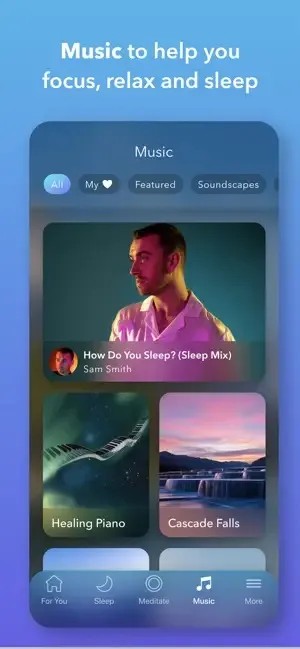
A racing mind at bedtime: Calm
Grade C. Calm is a meditation app with sleep stories, soundscapes, sleep music and breathing exercises11. In an 8-week trial of 263 adults with sleep disturbance, people asked to meditate with Calm for 10 minutes a day had less daytime fatigue, less daytime sleepiness and less pre-sleep arousal than a wait-list group10. The abstract does not report a between-group difference in sleep quality, and a wait-list control can't rule out expectation effects. So it's a reasonable wind-down tool, not an insomnia treatment.
Calm's in-app purchases on the US App Store were listed from $14.99 to $79.99 on November 2, 2026; the listing doesn't say which is monthly or annual11. Headspace is a similar alternative; we found no comparable sleep trial for it in our searches.
Sleep schedule and sleep debt: RISE
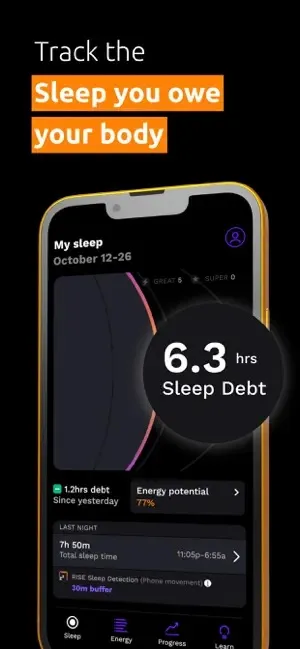
Grade D for the app itself, built on sound lab science. RISE estimates your personal sleep need from up to 365 nights of data, then tracks a "sleep debt" over the last 14 nights, weighting recent nights more17. It also predicts daily energy peaks and dips from your circadian rhythm and suggests a bedtime and wake time16. The idea that sleep loss adds up is well supported: in a lab study, two weeks at 6 hours a night produced growing deficits in attention, while people's own sense of sleepiness levelled off18. We found no published trial showing that RISE's own estimates or advice improve sleep or performance. It costs $69.99 a year with a 7-day free trial, on iPhone and Android16.
Read our full RISE review for how its model works and what it can and can't tell you.
Tracking with just a phone: Sleep Cycle
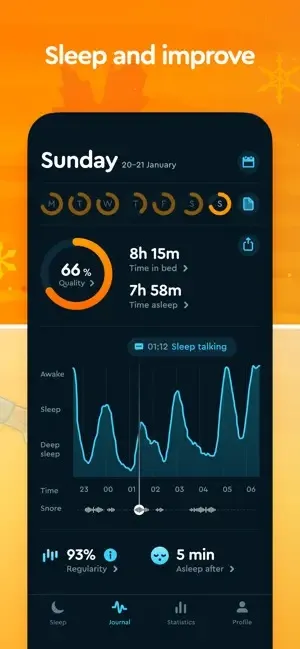
Grade C for detecting sleep in good sleepers, D for sleep stages. Sleep Cycle tracks sleep with sound analysis or the phone's motion sensor, flags snoring and sleep talking, and has a smart alarm that aims to wake you in light sleep15. A review of 11 validation studies found phone apps can detect sleep about as well as wrist actigraphy in healthy sleepers, but are poor at spotting wake time and at sleep stages, and Sleep Cycle performed poorly in clinical groups13. Treat its graphs as a rough diary, not a measurement.
It's a free download; Premium in-app purchases were listed from $2.99 to $57.99 on November 2, 202615. Its App Store privacy label lists health, location, contact info and identifiers as data linked to you, and identifiers as used for tracking15. Recording audio in the bedroom also captures anyone else there.
Already wear a tracker: use its own app
If you already wear an Oura ring, a WHOOP strap, an Apple Watch or a Garmin, its own app will log sleep more consistently than adding a phone app on top. The same accuracy caveats apply. We compare them in best smart rings, WHOOP vs Oura vs Garmin and best recovery wearables. RISE can read data from these devices if you want its sleep-debt view16.
See the Oura Ring 5 · See WHOOP
Sleep sounds: no pick
A systematic review of 38 studies rated the evidence that continuous or white noise improves sleep as very low certainty, and called for better studies before it is promoted as a sleep aid12. If a fan or rain sound helps you, Calm and RISE both include sounds, and many phones have a free built-in option. We don't recommend paying for a separate noise app. Our binaural beats guide covers that related idea.
Price and platform table
Price checked November 2, 2026 on the App Store listing or the developer's site cited. App Store listings show a list of in-app purchase prices without always saying which plan each one is, so we give the range shown.
| App | Main job | Price | Platforms | FDA status | Evidence grade |
|---|---|---|---|---|---|
| SleepioRx | Digital CBT-I | Via prescription; no consumer price listed5 | Not stated on the page we checked | Cleared (K233577)4 | A (digital CBT-I) |
| Somryst | Digital CBT-I | Via prescription or employer/health plan; no consumer price listed7 | Not checked | Cleared (K191716)6 | A (digital CBT-I) |
| CBT-i Coach | CBT-I self-help | Free9 | iPhone (App Store listing checked) | Not cleared | C (app alone)8 |
| Calm | Meditation and wind-down | $14.99 to $79.99 in-app purchases11 | iPhone (listing checked) | Not cleared | C10 |
| RISE | Sleep debt and schedule | $69.99 a year, 7-day trial16 | iPhone, Android16 | Not cleared | D (app); lab science A18 |
| Sleep Cycle | Phone-based tracking, smart alarm | Free; Premium $2.99 to $57.99 in-app purchases15 | iPhone (listing checked) | Not cleared | C/D (accuracy)13 |
Evidence map: graded by outcome
Grades: A consistent randomized trials or meta-analyses. B supported by randomized trials that are small or varied. C few or mixed trials, or trials showing no effect. D lab, animal or anecdotal only, or no trials of the app itself. X a safety signal or a way it can backfire.
| Outcome | Grade | Best evidence | Notes |
|---|---|---|---|
| Digital CBT-I for chronic insomnia | A | 33 RCTs, 9,364 people: Insomnia Severity Index −5.0 points after treatment, −3.5 at one year2. 1,711-person RCT: better functional health and wellbeing at 24 weeks3. | Most trials used structured programs (several weeks of sessions), not a sleep tracker |
| Digital vs face-to-face CBT-I | B | Face-to-face was about 3 points better on the ISI, within the authors' non-inferiority margin2. | A therapist is better if you can get one |
| CBT-i Coach used on its own | C | Pilot RCT of 33 veterans; scores improved but there was no no-app control8. | Designed to support a clinician9 |
| Meditation app (Calm) for sleep-related symptoms | C | One RCT, 263 adults: less fatigue, daytime sleepiness and pre-sleep arousal vs wait-list10. | No between-group sleep-quality result reported in the abstract |
| White or continuous noise for better sleep | D | Systematic review of 38 studies: very low certainty12. | Can still mask disruptive noise; evidence is weak |
| Phone app measuring sleep and wake | C | Similar to actigraphy for sleep in healthy users; poor at wake time; worse in clinical groups13. | Not a substitute for a sleep study |
| Phone app measuring sleep stages | D | Accelerometer apps correlated poorly with polysomnography stages13. | Ignore "deep sleep" percentages from a phone |
| Sleep-debt apps improving energy or performance | D | No trials of the apps found. The underlying lab science on cumulative sleep loss is strong18. | Useful as a prompt to keep a regular schedule |
| Trackers making sleep worse | X | Case series: some patients became anxious about their data or spent longer in bed to raise their scores ("orthosomnia")14. | Stop tracking if it makes you anxious |
How to choose a sleep app
- Start with the problem. Trouble falling or staying asleep most nights for months is the problem CBT-I was built for. Feeling tired despite enough time in bed is a reason to see a clinician, not to download a tracker.
- One app is enough. A CBT-I program already includes a sleep diary and wind-down techniques. Stacking a tracker, a sound app and a meditation app adds screen time at bedtime.
- Check what it measures. Phone apps infer sleep from sound or movement. They can't tell lying awake quietly from sleeping very well13, 14.
- Read the privacy label. Sleep audio and health data are sensitive. Check the App Store privacy section before granting microphone access15.
- Count the yearly cost. Several apps renew automatically after a short free trial. Set a reminder before it ends.
Safety: who should see a clinician first
- Loud snoring, pauses in breathing, gasping, or morning headaches: these can mean sleep apnoea, which needs a proper sleep study. Phone apps can't diagnose it14.
- Insomnia alongside depression, anxiety or another health condition: talk to a clinician before starting a self-guided program.
- Severe daytime sleepiness, especially if you drive for work: get it assessed rather than tracked.
- If tracking makes you more anxious about sleep, stop. That pattern has a name in the sleep literature14.
Myths
- "My app says I got 40 minutes of deep sleep." Phone apps are poor at sleep stages13. Treat stage numbers as noise.
- "FDA-registered" or "clinically proven" on an app store page. Only two insomnia programs on this page are FDA-cleared4, 6. Look for the K number.
- "You can't feel sleep debt, so you don't have it." In the lab, people's sleepiness ratings levelled off while their performance kept getting worse18.
- "White noise is proven to improve sleep." The certainty is very low12.
FAQ
What is the best app for insomnia?
A CBT-I program. The FDA-cleared options (SleepioRx, Somryst) need a prescription4, 5, 6. CBT-i Coach is a free starting point9.
Do sleep tracking apps work?
They give a rough picture of when you slept in healthy sleepers. They are much less reliable for wake time, for sleep stages and for people with insomnia13.
Is Calm or Headspace better for sleep?
Calm has a randomized trial in adults with sleep disturbance10. We didn't find a comparable trial for Headspace. Pick the one whose voice and content you'll actually use.
Is RISE worth $69.99 a year?
If a sleep-debt number gets you to keep a regular schedule, it may be. It isn't an insomnia treatment and its estimates aren't independently validated. See our RISE review.
Can a sleep app diagnose sleep apnoea?
No. Some apps flag snoring, but snoring alone doesn't confirm or rule out apnoea. Ask a clinician about a sleep study14.
Do I need a wearable?
No. For insomnia, a written or in-app sleep diary is what CBT-I uses. A wearable adds data, not treatment.
What changed in this update
The 2023 version of this page listed seven apps, including Noisli, Pzizz and Endel. We dropped the three sound and music apps because the evidence for noise as a sleep aid is very low certainty12 and they overlapped with Calm and RISE. We added CBT-I programs, FDA status and evidence grades, and removed testing claims we couldn't document.
Related guides
- RISE sleep app review
- Best smart rings, by evidence
- WHOOP vs Oura vs Garmin for recovery
- Best bed cooling systems
- Mouth taping: what the evidence says
- Best magnesium supplements by goal
- Tart cherry for recovery and sleep
References
Prices and listings were checked on November 2, 2026.
- Qaseem A, Kansagara D, Forciea MA, et al; Clinical Guidelines Committee of the American College of Physicians. Management of chronic insomnia disorder in adults: a clinical practice guideline from the American College of Physicians. Annals of Internal Medicine, 2016;165(2):125-133. doi:10.7326/M15-2175 (CBT-I as initial treatment: strong recommendation, moderate-quality evidence). Source
- Efficacy of digital cognitive behavioural therapy for insomnia: a meta-analysis of randomised controlled trials. Elsevier, 2020. PMID 32950013 (33 RCTs, 9,364 participants). Source
- Espie CA, Emsley R, Kyle SD, et al. Effect of digital cognitive behavioral therapy for insomnia on health, psychological well-being, and sleep-related quality of life: a randomized clinical trial. JAMA Psychiatry, 2019;76(1):21-30 (1,711 adults). Source
- US FDA. 510(k) premarket notification K233577: Sleepio (Big Health Inc.), decision date 5 August 2024, product code QVO, regulation 882.5801, computerized behavioral therapy device for insomnia. Source
- Big Health. US FDA grants clearance for SleepioRx. 8 August 2024 (prescription, adults 18 and older, adjunct to usual care). Source
- US FDA 510(k) K191716 (Pear Therapeutics; marketed as Somryst), decision date 23 March 2020, product code QVO. Record viewed via RegDataLab. Source
- Sleep Review. Nox Health closes acquisition of Somryst. 21 June 2023. Source
- Reilly ED, Robinson SA, Petrakis BA, et al. Mobile intervention to improve sleep and functional health of veterans with insomnia: randomized controlled trial. JMIR Formative Research, 2021;5(12):e29573 (pilot, 33 randomized, both arms used CBT-i Coach). Source
- US Department of Veterans Affairs. CBT-i Coach, Apple App Store listing: free; "intended to augment face-to-face care with a healthcare professional". Checked 2 November 2026. Source
- Huberty JL, Green J, Puzia ME, et al. Testing a mindfulness meditation mobile app for the treatment of sleep-related symptoms in adults with sleep disturbance: a randomized controlled trial. PLoS ONE, 2021;16(1):e0244717 (263 randomized; Calm vs wait-list, 8 weeks). Source
- Calm: Sleep & Meditation, US Apple App Store listing: in-app purchases listed from $14.99 to $79.99; Sleep Stories, soundscapes, breathing exercises. Checked 2 November 2026. Source
- Riedy SM, Smith MG, Rocha S, Basner M. Noise as a sleep aid: a systematic review. Sleep Medicine Reviews, 2021;55:101385 (38 studies; GRADE certainty very low). Source
- Fino E, Mazzetti M. Monitoring healthy and disturbed sleep through smartphone applications: a review of experimental evidence. Sleep and Breathing, 2019;23:13-24 (11 validation studies). Source
- Baron KG, Abbott S, Jao N, Manalo N, Mullen R. Orthosomnia: are some patients taking the quantified self too far? Journal of Clinical Sleep Medicine, 2017;13(2):351-354. doi:10.5664/jcsm.6472 (case series). Summary via ScienceDaily. Source
- Sleep Cycle, Apple App Store listing: free download, Premium in-app purchases listed from $2.99 to $57.99; sound-based or accelerometer-based sleep detection; snore and sleep-talk detection. Checked 2 November 2026. Source
- RISE Science. Product summary (llms.txt): $69.99 per year, 7-day free trial, iPhone and Android, optional wearable data. Checked 2 November 2026. Source
- RISE Science Help Center. How is my sleep debt calculated? (14-night window, sleep need estimated from up to 365 nights). Checked 2 November 2026. Source
- Van Dongen HPA, Maislin G, Mullington JM, Dinges DF. The cumulative cost of additional wakefulness: dose-response effects on neurobehavioral functions and sleep physiology from chronic sleep restriction and total sleep deprivation. Sleep, 2003;26(2):117-126 (48 adults). Source
Featured photo by Artur Łuczka on Unsplash.